Why Snacks Packing Machines Need Precision Weighing for Nuts and Mixtures
A pouch of salted peanuts and a pouch of Bombay mix look alike on a shelf. On a packaging line, they behave very differently.
Peanuts are small, dense, and roll freely. Cashews are larger and curved. Mixtures combine sev, boondi, lentils, peanuts, and flakes, each with its own size and flow behaviour.
Snacks Packing Machines must handle these differences while filling every pouch to its declared weight. Manual portioning with scoops and scales depends on operator judgement, slows output, and increases handling, breakage, and contamination risk.
Precision weighing measures each portion automatically before it enters the pack. It works well only when the feeding, hopper, and discharge setup suits the product.
That is why Fair Pack Machineries encourages manufacturers to evaluate equipment against their actual products. A Nuts Packing Machine set up for whole almonds may need adjustment before it can run a light, flaky namkeen.
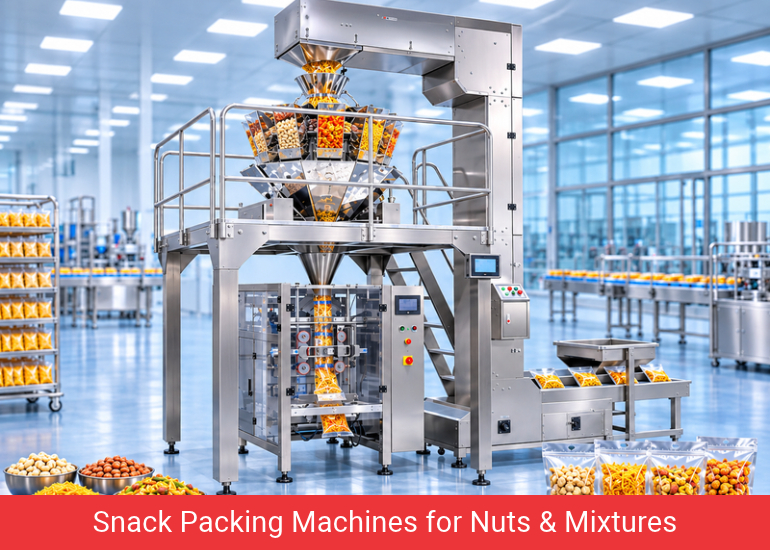
How a Multihead Weigher Packaging Machine Handles Different Snacks
A Multihead Weigher Packaging Machine builds each portion by combining several smaller weights instead of filling one large measure.
- Distribution: Product lands on a central top cone and spreads to radial feed pans. Vibration moves it along each pan.
- Pool hoppers: Each pan feeds a pool hopper that holds product briefly.
- Weigh hoppers: Product drops into weigh hoppers, each with a load cell that records its weight.
- Combination selection: The controller finds the group of hoppers that adds up closest to the target weight.
- Discharge: Only the selected hoppers open, releasing product through a collating chute. The rest refill for the next cycle.
Because many combinations are available each cycle, the weigher can form an accurate portion from irregular individual quantities.
Vibration intensity, feed timing, hopper opening, and chute design are set for each product during commissioning. Fair Pack Machineries’ multihead weigher systems are configured around the snack being packed rather than a fixed default.
Nuts Packing Machine and Nuts Filling Machine: Handling Peanuts, Almonds and Cashews
A Nuts Packing Machine must account for wide differences within one product family.
Peanuts roll easily, while almonds slide rather than roll. Cashews are curved and prone to splitting, which lowers their grade. In-shell pistachios are light for their size, and walnut kernels are fragile and irregular.
These differences shape how a Nuts Filling Machine is set up:
- Feed control: Free-rolling nuts may need gentler vibration; slower-moving almonds may need more.
- Drop height: Whole cashews and walnut halves need reduced drops and controlled transfer points.
- Contact surfaces: Oily or salted nuts leave residue, so surface finish and cleanability matter.
- Portion size: With large nuts, each piece is a bigger share of the target weight, which affects how closely portions can be matched.
Mixture Packing Machine and Namkeen Packing Machine: Managing Mixed Components
A Mixture Packing Machine handles a blend rather than a single item. A typical namkeen may contain fine sev, round boondi, dense peanuts, lentils, and light cornflakes.
During conveying and storage, these components separate. Small, dense pieces settle while large, light pieces rise.
As a result, the product reaching the weigher may not match the blend that left the mixer.
A Mixture Filling Machine weighs the total portion. That alone does not guarantee an identical ingredient ratio in every pouch.
One pack can meet its target weight while holding more peanuts and fewer flakes than the next. Producers using a Namkeen Packing Machine can limit this variation by:
- Keeping the supply hopper level steady.
- Shortening transfer distances before weighing.
- Packing soon after mixing.
- Weighing components separately where the recipe ratio is critical.
Our Other Products
Product Size, Density and Fragility in Snacks Packaging Machine Selection
Beyond individual products, four physical properties decide which weighing and filling technology a Snacks Packaging Machine should use.
Size and shape affect how consistently a fixed volume holds the same weight. Small, uniform pieces pack predictably; large or irregular pieces leave varying gaps.
Bulk density affects equipment sizing. Low-density snacks need larger hoppers and pouches for the same weight, while dense products need less volume.
Flow behaviour affects the feeding method. Free-flowing products move reliably through cups and chutes, while sticky or seasoned products may need vibratory feeding and suitable contact surfaces.
Fragility affects the whole line layout. Every transfer point, from elevator discharge to forming tube, adds breakage risk and fines that can contaminate seals.
Volumetric cup fillers can suit uniform, free-flowing products, while combination weighing is often considered for irregular or mixed snacks. The right method depends on product behaviour, target-weight requirements, and machine performance validated on the actual product.
How Snacks Packing Machines Deliver Consistent Portion Control
Portion control starts with the target weight. It must be configured so packs meet the declared net quantity and applicable legal metrology requirements, taking account of product variation and the manufacturer’s control strategy.
Individual pieces vary in weight, so no single handful matches the target exactly. Combination weighing improves the match by selecting the best combination each cycle.
The closer each portion lands to the target, the less product giveaway: product packed above the declared weight without charge.
Three terms should be kept separate:
| Term | Meaning |
|---|---|
| Weighing accuracy | How closely a portion matches the set target |
| Portion consistency | How little pack weights vary across a run |
| Ingredient distribution | How evenly mixture components are shared between packs |
A weigher can perform well on the first two and still produce uneven ingredient distribution in a mixture.
Real performance depends on the product, piece size, target weight, line speed, and plant conditions. Fair Pack Machineries recommends judging results from trials with the manufacturer’s own product.
Multihead Weigher Filler Integration with VFFS Packing Machines
The weigher is one stage in a line that feeds, forms, fills, seals, and discharges packs. Each stage must keep pace without starving or flooding the next.
- Product infeed: A bucket elevator or inclined conveyor lifts product to the weigher, ideally with level sensing.
- Multihead Weigher Filler: Mounted above the bagger, it releases each portion on a signal from the packaging machine.
- VFFS packing machine: It forms a pouch from film around a forming tube, receives the portion, then seals and cuts the pack.
- Finished-pack handling: An output conveyor carries sealed pouches to checking or cartoning.
Timing between weigher discharge and the sealing jaws is critical. A late or trailing portion can get caught in the seal, causing leaks and rejects.
Fair Pack Machineries supplies multihead weighers, VFFS packing machines, conveyors, and elevators. This allows manufacturers to plan the infeed, weighing, and sealing stages as one integrated line.
Managing Multiple SKUs on Chips and Snacks Packing Machines
Few producers run one product all year. A single line may pack peanuts in the morning, a spicy mixture after lunch, and premium cashews for a festive order.
On shared Chips and Snacks Packing Machines, each changeover can involve:
- New target weights and pack sizes, sometimes needing a different forming tube or film width.
- Setting changes for vibration, feed timing, and hopper opening. Stored product recipes, where supported, shorten set-up.
- Cleaning pans, hoppers, and chutes, especially after seasoned or allergen-containing products.
- Trial packs to confirm weight and seal quality before full production.
Scheduling reduces downtime. Run plain products before seasoned ones and allergen-free before allergen-containing products.
Grouping SKUs that share a pack size also limits format-part changes.
Choosing a Nuts Packing Machine or Mixture Packing Machine
Before approaching suppliers, define:
- Product type: single nut, mixed nuts, or multi-component namkeen.
- Physical properties: size range, bulk density, fragility, oil or seasoning content.
- Target weights and pack formats: pouch style, dimensions, and film.
- Weighing head configuration: number of heads and hopper size for the required output.
- Material handling: elevator type, conveyor layout, and available ceiling height.
- VFFS compatibility: forming tube size, sealing type, and signal interface.
- Hygiene and maintenance: contact materials, cleaning access, and wear parts.
- Expansion: future products or volumes needing added capacity.
When contacting Fair Pack Machineries, send representative samples, including the most fragile varieties, with the film you plan to use.
Share target weights, expected daily output, and current reject or giveaway concerns. This makes the machinery evaluation faster and more accurate.
Choosing the Right Snacks Packing Machine
The right choice comes from matching the line to the product. Nut packers prioritise gentle handling, namkeen producers prioritise segregation control, and mixed operations need changeover flexibility.
Fair Pack Machineries manufactures and supplies snack packing machinery, multihead weigher systems, VFFS packing machines, conveyors, elevators, and integrated food packaging solutions.
Share your product samples and packing requirements with the Fair Pack Machineries team to discuss a suitable line configuration.