Why Choosing the Right Automatic Multihead Weigher Matters
Snack makers, grain processors and contract packers are replacing manual or volumetric filling with industrial weighing equipment that controls every pack more tightly.
An Automatic Multihead Weigher often sits at the centre of that shift. Yet buying one is not about picking the model with the most heads or the highest advertised speed.
Two machines with similar brochures can perform very differently on the same product. Results depend on how well the heads, hoppers and feeders suit your product, and how smoothly the weigher connects with the packing machine below it.
In this guide, Fair Pack Machineries outlines the multihead weigher machine features to evaluate before requesting a quotation.
Multihead Weigher Heads and Combination Weighing Technology
A multihead weigher works on combination weighing. Product is divided across several weighing hoppers, each with a load cell recording the weight it holds.
The controller calculates which group of hoppers adds up closest to the target weight. Only those hoppers discharge into the collecting chute, and the emptied ones refill while the next combination is selected.
The number of heads sets how many combinations are available in each cycle. More available combinations can help the machine identify suitable portions when individual piece weights vary, although performance also depends on hopper capacity, product flow, target weight and required speed.
However, more heads also mean a larger footprint, more parts to clean and a higher investment. For uniform, free-flowing products, a smaller configuration may be enough. Fair Pack Machineries lists 10-head and 14-head options for its multihead weigher packaging machine; confirm which suits your application.
When discussing configuration with Fair Pack Machineries or any supplier, ask:
- Which head count suits my product and target weight, and why?
- How is discharge timed so selected portions reach the chute together?
- Can the configuration be adapted if my product range changes?
Multihead Weigher Machine Features: Hopper Design and Product Feeding
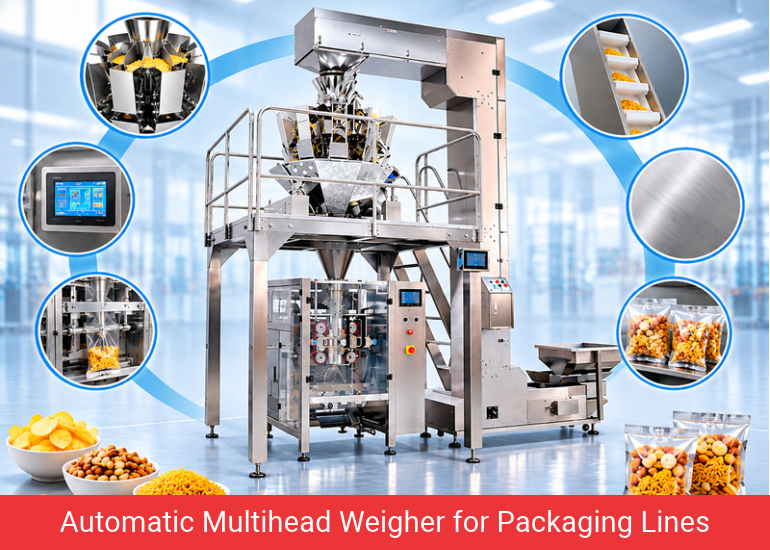
Product must be spread evenly across all heads before weighing. In a typical design, it drops onto a top distribution cone, moves outward along vibrating radial pans and enters feed hoppers before reaching the weighing hoppers.
Uneven distribution leaves some hoppers overfilled and others nearly empty, which reduces usable combinations.
Products behave differently along this path:
- Free-flowing granules move readily with mild vibration.
- Irregular pieces may bridge or tumble unevenly.
- Sticky or oily products can cling to pans and hopper walls, causing buildup and interrupted flow.
- Fragile items need shorter drops and gentler gate action.
Ask whether vibration is adjustable per pan, which contact-part finishes suit sticky products, and how gate movement can be set for delicate items.
Automatic Multihead Weigher Product Compatibility for Your Application
Size and shape come first. Long or large pieces need hoppers and chutes sized to prevent jamming.
Bulk density matters next. Light products such as chips fill large volumes at low weights, while sugar or pulses reach target weight in far less space.
Fragile snacks and certain nuts can break during transfers, affecting pack appearance. Namkeen blends or mixed dry fruits may also separate under vibration, leaving uneven proportions in each pack.
A setup suited to rice may not suit potato chips. At this stage, the question is simply whether the machine can handle your product without jamming, breakage or segregation, which a short trial with real samples can confirm.
Fair Pack Machineries can review your product samples and application to discuss whether a suitable configuration is available before you commit.
Automatic Weighing System Controls, Target Weights and Pack Sizes
Define your target pack weights and packaging formats before comparing machines. A weigher sized for small retail pouches may not handle larger packs efficiently.
The control panel is where operators set target weights, adjust feeding and review data. Verify these points for your operation:
- How target weights and feeding parameters are entered and adjusted.
- Whether product settings can be stored as recipes for SKU changeover, where supported.
- Whether user access levels restrict who changes weight settings.
- Which language and display options suit your operators.
- What operating data, such as counts or rejected portions, the controller records.
Fair Pack Machineries lists a PLC-based touch screen HMI for its multihead weigher packaging machine. Confirm which of the functions above, such as recipe storage, are available on the model proposed for your line.
Industrial Weighing Equipment Performance and Production Requirements
Once suitability is confirmed, the next question is whether the proposed automatic weighing system delivers your required output: packs per shift, number of SKUs and planned operating hours.
Performance is not a fixed machine number, so verify it through sustained production trials rather than short demonstrations or brochure figures.
Two results to record during these trials:
- Portion consistency: how closely packs match the target across a sustained run.
- Product giveaway: excess product above the declared weight, which adds up to real material cost over a year.
The weigher is only one part of the line. Final output also depends on the packing machine’s cycle, film handling and sealing, so record both weighing results and combined line speed during trials.
Our Other Products
Multihead Weigher Packaging Machine Integration with VFFS
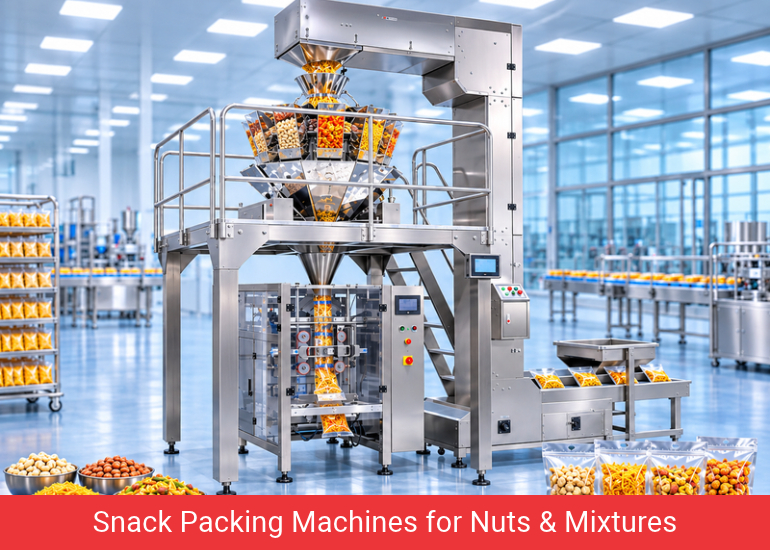
In a Multihead Weigher Packaging Machine setup, the weigher sits on a platform above a vertical form fill seal (VFFS) machine. A Z-type conveyor or bucket elevator feeds it, chosen for gentle handling of your product.
The VFFS machine forms the pouch from roll film, receives the portion from the Multihead Weigher Filler, then seals and cuts the pack.
Weigher discharge and pouch formation must be synchronised. Poor timing can trap product in the seal area or leave pouches partly filled.
When evaluating a complete multihead weigher packing machine line, check:
- Signal exchange between the weigher and the Automatic Packing Machine.
- Feed conveyor control based on product level in the weigher.
- Platform height, stairs and footprint against available space.
- Finished-pack discharge to take-off conveyors or checkweighers.
- Compatibility with existing equipment if you are upgrading.
Fair Pack Machineries offers a multihead weigher packaging system with a collar-type pouch forming section and conveyor interface. Confirm the suitable machine configuration for pillow, gusset, stick or three-side-sealed pouch formats according to the required pack design.
Cleaning and Maintenance Features of a Multihead Weigher Packing Machine
Distribution plates, feeding pans, hoppers and chutes collect residue and need cleaning at intervals suited to your product. Oily or sugar-coated items usually need more frequent attention than dry grains.
Check how easily these parts can be reached and whether hoppers are removable on the offered model. Fair Pack Machineries lists SS 304 or SS 316L as product-contact material options; verify which grade is supplied and appropriate for your application. Ask the supplier to specify approved cleaning methods rather than assuming the machine supports washdown.
For maintenance, review access to load cells, drives and wiring, how calibration is done, and which routine checks the manufacturer recommends.
Clear on-screen prompts and alarms also help operators spot empty pans or blocked hoppers quickly.
Choosing a Multihead Weigher Manufacturer for Installation and Support
When evaluating a multihead weigher manufacturer, ask:
- Who handles installation, commissioning and site trials?
- What documentation is supplied, such as manuals, electrical drawings and spare parts lists?
- How are operators and maintenance staff trained?
- Which spares should be stocked, and how quickly can others be supplied?
- What do warranty terms cover?
- Will the weigher work with equipment you may add later?
Put these questions to Fair Pack Machineries during early discussions so installation, training and service terms are clear in writing before purchase.
Automatic Multihead Weigher Selection Checklist
Prepare this information before requesting a proposal for an Automatic Multihead Weigher:
| Area | What to prepare or confirm |
|---|---|
| Product | Samples, piece size, bulk density, fragility, stickiness |
| Weights and output | Target pack weights, packs per shift, number of SKUs |
| Weigher configuration | Recommended head count and hopper design, with reasons |
| Controls | Recipe storage, access levels, operator training |
| Line integration | VFFS model, pouch style, film specification, elevator type, floor space |
| Hygiene and maintenance | Cleaning frequency, component access, recommended routines |
| Supplier | Installation, documentation, spare parts, warranty |
| Future needs | New products, pack sizes or additional lines |
Share this checklist with Fair Pack Machineries to receive a configuration proposal matched to your product. Arrange a trial using your own samples, then review the recorded weighing performance, line output, service support and warranty terms before making a decision.