
Fair Pack

Leading Packaging Machinery Manufacturer – Aseptic, VFFS, Multihead Weigher, Auger Filler, Flow Wrap, PFS & Semi-Automatic Machines | Serving India, UAE, Saudi Arabia, Africa, Europe, USA & More

Semi-Automatic vs Fully Automatic Packaging Machines: Which Is Right for Brazil's Mid-Size FMCG Brands?

Brazil is one of South America’s most dynamic FMCG markets. With a population of over 215 million, a fast-growing middle class, and consumer demand spanning food, beverage, personal care, and household goods, the country presents an enormous opportunity for manufacturers who can package products efficiently, consistently, and at the right cost. For mid-size FMCG brands in São Paulo, Belo Horizonte, Curitiba, and beyond, the question of which packaging machine to invest in — semi-automatic or fully automatic — is one of the most important capital decisions they will face.

This article provides a structured comparison to help Brazilian FMCG manufacturers choose between semi-automatic packaging machines and fully automatic packaging machines based on production scale, product range, and growth ambitions.

Speak with an Expert
Call Call Us Now!

Understanding the Brazilian FMCG Packaging Landscape

Brazil’s FMCG sector is characterised by enormous diversity. A single manufacturer may pack sachets of powdered juice, pouches of dried beans, bags of coffee, bottles of cleaning liquid, and sealed packs of biscuits — often all on the same production floor. This variety demands packaging solutions that are versatile, reliable, and scalable.

The packing machine South America market has seen significant investment growth over the past decade, driven by increasing retail formalisation, supermarket chain expansion, and rising export volumes to Argentina, Chile, and European markets. Brazilian brands exporting internationally face particularly high demands for packaging consistency, labelling accuracy, and seal integrity.

At the same time, labour costs in Brazil have risen steadily, making manual packaging increasingly expensive and unreliable at scale — pushing mid-size manufacturers to evaluate automation more seriously than ever before.

What Is a Semi-Automatic Packaging Machine?

A semi-automatic packaging machine requires human involvement at one or more stages of the packaging process. Typically, an operator positions the bag or pouch, the machine fills and seals, and the operator removes the finished pack. Some semi-automatic machines automate filling and sealing but require manual feeding of film or pre-formed bags.

Common types used in Brazilian FMCG include:

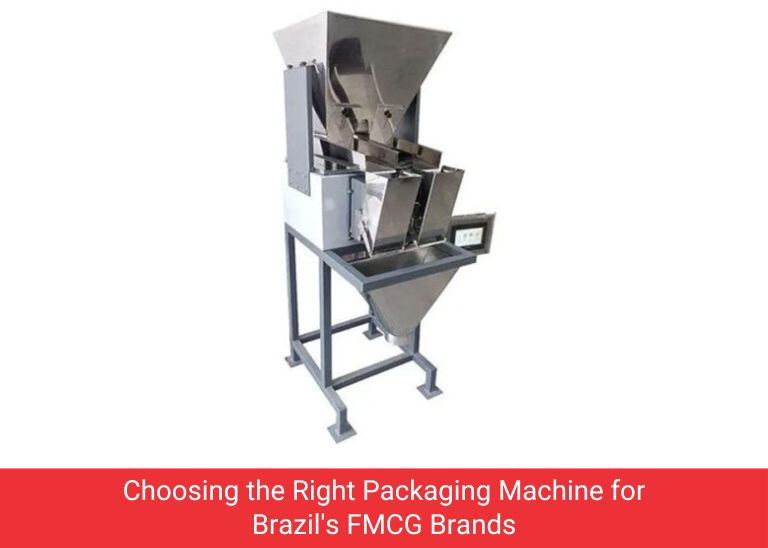
  • Semi-automatic auger filling machines — for powders like flour, coffee, spice mixes, and protein supplements
  • Semi-automatic volumetric cup fillers — for granules, pulses, sugar, and grains
  • Semi-automatic liquid filling machines — for sauces, oils, cleaning liquids, and syrups
  • Semi-automatic band sealers — for sealing pre-filled bags across a wide range of products
  • Semi-automatic collar-type packing machines — for forming and sealing pouches of dry products

These machines are compact, low in cost, and can be installed quickly. For a Brazilian brand running two or three product SKUs at moderate volumes — 500 to 2,000 packs per hour — a semi-automatic line often delivers the right balance of investment and output.

What Is a Fully Automatic Packaging Machine?

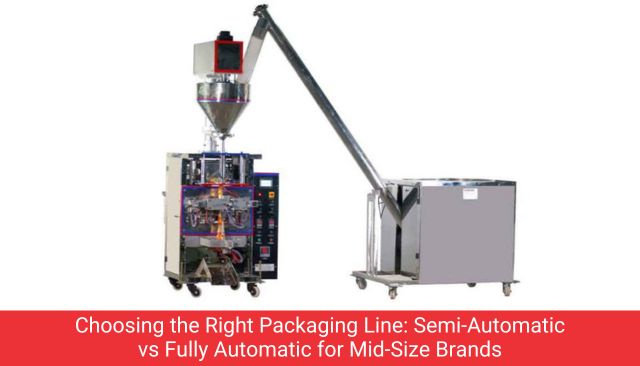
A fully automatic packaging machine performs the entire cycle — film unwinding, bag forming, filling, sealing, cutting, and discharge — without manual intervention. Once set up and loaded with product and film, the machine runs continuously, requiring only periodic monitoring and maintenance.

Fully automatic packaging systems relevant to the Brazilian FMCG market include:

  • Vertical Form Fill Seal (VFFS) machines — for pouches of powder, granules, and small solids
  • Multitrack packaging machines — for high-speed sachet production of sugar, salt, and spice
  • Multihead weigher packing machines — for accurate weighing and packing of snacks, nuts, and mixed products
  • Flow wrap machines (HFFS) — for biscuits, chocolates, and bakery products
  • FFS volumetric packing machines — for grains, pulses, and free-flowing products
  • Automatic liquid packing machines — for oils, beverages, and sauces at high throughput

These machines deliver speeds from 2,000 to over 10,000 packs per hour depending on product and machine type, and require less labour per unit produced while offering consistent seal quality and production data for quality control.

Key Comparison: Semi-Automatic vs Fully Automatic for Mid-Size Brands

Production Volume and Speed

The most fundamental decision factor is daily output. If a Brazilian brand needs to produce 5,000 pouches per shift or fewer, a semi-automatic machine is often adequate. If the target is 15,000 to 100,000+ packs per day, a fully automatic line becomes necessary.

Mid-size brands experiencing growth often start with semi-automatic machines and scale to fully automatic lines as volumes increase — a phased approach that is both financially sensible and operationally manageable.

Investment Cost and ROI

Semi-automatic packaging machines are significantly more affordable upfront. A good-quality semi-automatic auger filling machine or volumetric cup filler may cost a fraction of a comparable fully automatic VFFS line — making it ideal for Brazilian manufacturers working within tighter capital budgets or validating product-market fit.

However, when packaging machine Brazil ROI is calculated over a 3–5 year horizon, fully automatic systems often deliver stronger returns for brands with consistent, high-volume SKUs, because they reduce labour cost per unit significantly.

Labour Dependency and Operational Risk

Semi-automatic lines require trained operators at every station. In Brazil’s current labour market, managing operator turnover, training new staff, and maintaining output consistency across shifts is genuinely challenging. Absenteeism directly impacts production.

Fully automatic machines reduce this dependency. A single operator can monitor an entire automatic line, freeing the workforce for higher-value tasks and reducing exposure to labour disruption.

Product and SKU Flexibility

Semi-automatic machines are generally easier to switch between SKUs. Changing from a 100g to a 500g pouch on a semi-automatic machine may require only a cup volume or collar size adjustment — work a trained operator can do in minutes.

Fully automatic machines may require longer changeovers, though modern PLC-controlled machines with touchscreen HMI and recipe storage systems have reduced changeover times significantly, often to 15–30 minutes.

For Brazilian brands running many SKUs in small batches — common for specialty food brands, regional brands, and private-label manufacturers — a semi-automatic machine often provides better day-to-day flexibility.

Weight Accuracy and Compliance

Brazil’s INMETRO requirements for declared weight accuracy are strict. Brands selling through retail chains like Carrefour Brazil, GPA, or Assaí must consistently deliver packs within legal metrology tolerances.

Fully automatic machines — particularly multihead weigher packing machines and gravimetric filling systems — offer superior weight accuracy, typically within ±0.5–1g even for irregular products. This reduces product giveaway and minimises compliance risk.

Semi-automatic machines with manual operator involvement are more susceptible to weight variation. For high-value products or exports where international compliance is critical, this is an important consideration.

Hygiene and Food Safety

Both machine types can be manufactured with food-grade stainless steel (SS 304 or SS 316L) contact parts meeting Brazilian ANVISA and international food safety standards. However, fully automatic enclosed systems reduce human contact with the product, lowering contamination risk — particularly important for baby food, dairy powder, and nutritional supplements.

Which Machine Is Right for Your Brazilian FMCG Business?

Choose a semi-automatic packaging machine if:

  • Your production volume is below 5,000 packs per shift per SKU
  • You have multiple small-batch SKUs requiring frequent changeover
  • Your capital budget is limited and cash flow management is a priority
  • You are launching a new product and want to validate volumes before committing to full automation
  • Your product requires careful manual handling (fragile or irregular items)

Choose a fully automatic packaging machine if:

  • Your production volume consistently exceeds 5,000–8,000 packs per shift
  • You have one or more high-volume, stable SKUs running daily
  • You are exporting to international markets with strict quality requirements
  • Labour cost and operator dependency are significant operational risks
  • You are targeting modern retail chains that demand consistent packaging quality

Consider a hybrid approach if:

  • You are a mid-size brand in transition — running semi-automatic lines for small SKUs while investing in one or two fully automatic lines for your highest-volume products
  • You want to pilot automation on a single product line before rolling out across the factory

Why Indian-Made Packaging Machines Are Competitive in Brazil

Indian packaging machinery manufacturers have built a strong reputation for delivering technically advanced machines at price points that are 25–40% lower than comparable European alternatives. For Brazilian FMCG manufacturers, this creates a compelling opportunity — particularly for companies evaluating their first or second generation of packaging automation.

Indian-built machines handle diverse products — from fine powders to heavy granules, from viscous liquids to fragile snacks — and are designed with PLC controls, HMI touchscreens, servo drive systems, and stainless steel food-contact parts that meet international standards including CE marking and ANVISA-compatible hygiene norms.

Quick Response Guaranteed
Message us on WhatsApp Email Us Now!

Conclusion

The choice between semi-automatic and fully automatic packaging machines is not simply a budget question — it is a strategic decision that shapes operational capacity, product quality, labour structure, and competitive positioning in FMCG packaging São Paulo and beyond.

For Brazil’s mid-size FMCG brands, the most effective approach is to assess current volumes honestly, project a 3–5 year growth trajectory, and choose a machine that matches where the business will be — not just where it is today. Whether starting with a semi-automatic line or making the leap to a fully automatic VFFS or multihead weigher system, investing in the right packaging equipment is one of the clearest paths to scalable, sustainable growth in South America’s most competitive market.

x

Call now

    agree that Steeler will collect my name and email information
    ×