
Fair Pack

Leading Packaging Machinery Manufacturer – Aseptic, VFFS, Multihead Weigher, Auger Filler, Flow Wrap, PFS & Semi-Automatic Machines | Serving India, UAE, Saudi Arabia, Africa, Europe, USA & More

Aseptic Packing Machines in the UK: Meeting BRCGS and FSA Standards for Dairy and Beverage Manufacturers

The United Kingdom’s food and beverage manufacturing sector operates under some of the most rigorous quality and safety standards in the world. For dairy and beverage manufacturers — whether producing long-life milk, UHT cream, fruit juices, plant-based drinks, or nutritional beverages — ensuring that products reach consumers in a sterile, safe, and shelf-stable condition is non-negotiable. The aseptic packing machine has become an indispensable technology for achieving this, and UK manufacturers are under increasing pressure to invest in aseptic systems that not only perform to the highest technical standards but also comply fully with BRCGS (British Retail Consortium Global Standards) and FSA (Food Standards Agency) requirements.

This article explores how aseptic packing technology works, why it is critical for the UK dairy and beverage sector, and what manufacturers should consider when selecting an aseptic packing machine for their production lines.

The UK Dairy and Beverage Market: A Demanding Environment

The UK is home to a sophisticated and highly competitive food and beverage industry. Dairy remains one of the largest food categories, with production of UHT milk, cream, yoghurt drinks, and plant-based alternatives growing rapidly. The functional beverage market — including protein shakes, vitamin waters, cold-pressed juices, and kombucha — has expanded enormously since 2019, bringing with it an entirely new set of packaging challenges around hygiene, shelf life, and product integrity.

UK supermarkets and food retail chains — including Tesco, Sainsbury’s, ASDA, and Marks & Spencer — require their suppliers to hold BRCGS certification. This standard, recognised globally as one of the most stringent food safety benchmarks, sets detailed requirements for processing environments, equipment hygiene, contamination control, and documentation. For any manufacturer using aseptic packing technology, meeting BRCGS and FSA requirements is a fundamental commercial necessity, not just a regulatory one.

Call Now for Instant Assistance!
Call Call Now

What Is an Aseptic Packing Machine?

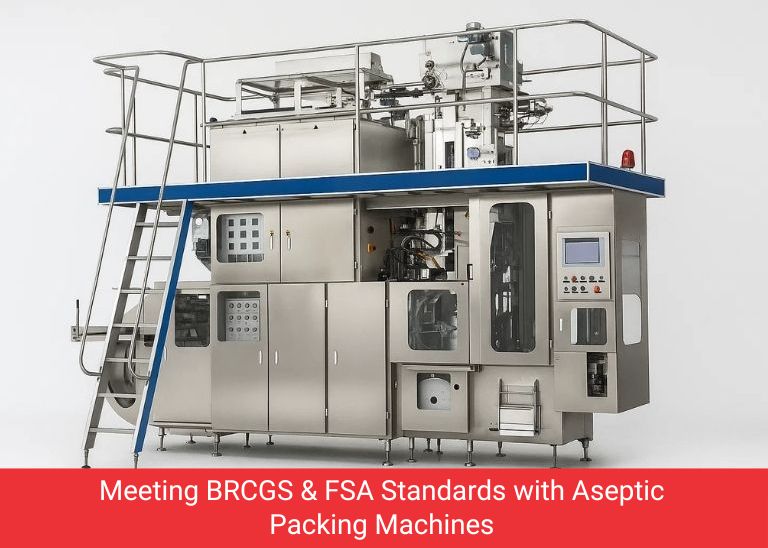
An aseptic packing machine is designed to fill sterilised product into pre-sterilised containers in a sterile environment, preventing post-processing contamination and extending shelf life without the need for refrigeration or preservatives. The aseptic process involves:

  • Product sterilisation — typically via UHT (Ultra High Temperature) treatment, heating the product to 135–150°C for a few seconds
  • Packaging material sterilisation — using hydrogen peroxide (H₂O₂), UV light, or steam to sterilise the inner surface of the container or film
  • Aseptic filling — dispensing the sterilised product into the sterilised container within a sterile zone
  • Hermetic sealing — closing the container to prevent any ingress of microorganisms

The result is a product with a shelf life of 6 to 12 months at ambient temperature — without refrigeration, without preservatives, and without compromising nutritional value or flavour.

Aseptic systems used in the UK dairy and beverage sector include:

  • Aseptic carton filling machines (Tetra Pak-style systems) for milk and juices
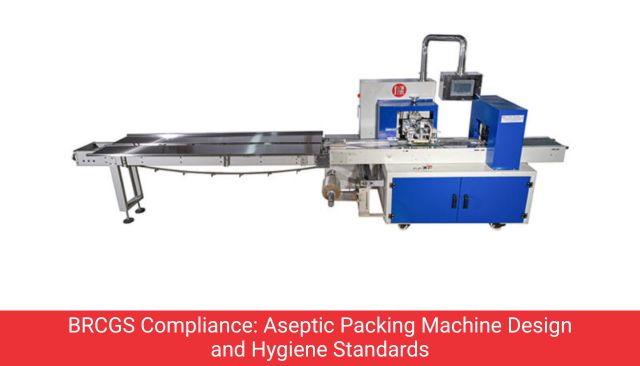
  • Aseptic pouch filling machines for liquid dairy and functional beverages
  • Aseptic bottle filling machines for juices and plant-based drinks
  • Aseptic bag-in-box systems for bulk ingredient packaging
  • Aseptic sachet filling machines for single-serve dairy and beverage products

BRCGS Compliance and Aseptic Packing

BRCGS Issue 9 — the current version of the global standard — sets specific requirements that directly impact the design and operation of aseptic packing machines in UK facilities. Key compliance areas include:

Equipment design and hygiene

BRCGS requires that all food contact surfaces be made from materials that are smooth, non-porous, non-absorbent, and resistant to corrosion. Aseptic packing machines for the UK market must therefore be built with SS 316L stainless steel food-contact parts, with no crevices, dead-legs, or joints where product or cleaning solutions can accumulate. CIP (Clean-in-Place) and SIP (Sterilise-in-Place) systems are essential — the machine must be cleanable and sterilisable without disassembly, and the cleaning process must be validated and documented.

Sterile zone integrity

BRCGS requires that the aseptic zone — the area where sterilised product meets sterilised packaging — be maintained under positive pressure with sterile filtered air (HEPA filtration) to prevent environmental contamination. The machine must include validated sterilisation cycles and continuous monitoring of the sterile barrier.

Process control and documentation

PLC-based control systems with full traceability — recording time, temperature, pressure, fill weight, sterilisation concentration, and seal integrity data for every batch and every pack — are essential for BRCGS audit compliance. Alarm systems, automatic reject mechanisms for out-of-specification packs, and integration with factory ERP/MES systems are increasingly expected by auditors.

Validation and qualification

BRCGS and FSA requirements demand that aseptic packing machines be validated before commercial production begins. This includes Installation Qualification (IQ), Operational Qualification (OQ), and Performance Qualification (PQ) — demonstrating that the machine consistently achieves the required level of sterility assurance (typically a 6-log reduction in the most resistant pathogen under worst-case conditions).

FSA Requirements and Food Safety in Aseptic Packing

The Food Standards Agency’s requirements for UK food manufacturers complement BRCGS by setting legal baseline standards for food safety, including hygiene regulations under the retained EU law framework. For aseptic dairy products, specific FSA guidance on UHT treatment validation, temperature monitoring, and tamper-evident packaging applies. Manufacturers must demonstrate that their aseptic process is capable of consistently delivering safe, shelf-stable product — and that documentation of this capability is maintained.

For sterile filling machine Britain applications, regulatory compliance is therefore not a one-time certification exercise but an ongoing operational discipline that starts with the design of the machine itself and continues through every production batch.

Key Technical Features to Specify for BRCGS/FSA-Compliant Aseptic Packing

When selecting an aseptic packing machine for a UK dairy or beverage facility, manufacturers should specify:

  • CIP and SIP systems with validated, automated cleaning and sterilisation cycles and full data logging
  • H₂O₂ sterilisation system for packaging material with integrated concentration monitoring and drying tunnel
  • Sterile air system with HEPA filtration and positive pressure maintenance in the aseptic zone
  • Load cell-based fill weight control for accurate, consistent dosing with automatic reject for underweight packs
  • Inline seal integrity testing — burst testing, leak detection, or ultrasonic seal inspection
  • Full PLC control with HMI touchscreen, batch traceability, and data export for BRCGS documentation
  • Stainless steel 316L food-contact surfaces with electropolished finish and no dead-legs
  • Servo-driven filling and sealing heads for precise, repeatable performance
  • Integrated date coding and labelling for traceability from line to retail shelf

Applications in the UK Dairy and Beverage Sector

Aseptic packing machines serve a wide range of applications in the UK market, including:

  • UHT milk and cream — pillow pouches, cartons, and bottles for retail and foodservice
  • Fruit juices and smoothies — aseptic pouch and bottle filling for ambient shelf display
  • Plant-based dairy alternatives — oat milk, almond milk, coconut milk in aseptic cartons and pouches
  • Nutritional and functional drinks — protein shakes, meal replacement drinks, and sports nutrition beverages
  • Infant formula liquid — aseptic filling into sterilised bottles or pouches requiring the highest sterility assurance
  • Soups and sauces — ambient shelf-stable liquid food products for retail and food service

The Commercial Case for Aseptic Packing Investment

Beyond compliance, investing in an aseptic packing machine delivers significant commercial advantages for UK manufacturers:

  • Extended shelf life of 6–12 months at ambient temperature reduces cold chain dependency and logistics cost
  • Reduced food waste through precise filling, hermetic sealing, and longer product life
  • Export opportunity — ambient shelf-stable products are easier and cheaper to export than chilled or frozen goods, opening markets in Europe, the Middle East, and beyond
  • Premium positioning — aseptic packaging is associated with freshness, quality, and safety, supporting premium pricing in UK retail
  • Reduced preservative use — a clean label advantage that resonates strongly with UK consumers
We’re Ready to Help!
Message us on WhatsApp Email Us

Conclusion

For UK dairy and beverage manufacturers, the aseptic packing machine is not a luxury — it is a competitive and regulatory necessity. As BRCGS and FSA standards continue to evolve and tighten, manufacturers who invest in technically advanced, well-validated aseptic systems will be best positioned to maintain retail supply, access export markets, and build brands that consumers trust.

Selecting the right aseptic packing machine — one that is built to meet the specific demands of BRCGS compliance, food safety regulation, and the operational realities of the UK dairy and beverage industry — is a decision that deserves thorough technical evaluation, clear specification, and investment in a supplier with deep expertise in aseptic technology.

x

Call now

    agree that Steeler will collect my name and email information
    ×