
Fair Pack

Leading Packaging Machinery Manufacturer – Aseptic, VFFS, Multihead Weigher, Auger Filler, Flow Wrap, PFS & Semi-Automatic Machines | Serving India, UAE, Saudi Arabia, Africa, Europe, USA & More

Why Egyptian Dairy and Beverage Brands Are Investing in Aseptic Packing Technology

Egypt is the most populous country in the Arab world, with a population exceeding 105 million and one of the fastest-growing food and beverage markets in Africa and the Middle East. Dairy products — including milk, yoghurt, flavoured drinks, and processed cheese — are among the most widely consumed food categories, and the demand for safe, shelf-stable, high-quality packaged beverages has grown dramatically over the past decade. Against this backdrop, Egyptian dairy and beverage manufacturers are making a strategic shift: investing in aseptic packing technology to extend product shelf life, reduce dependency on cold chains, and compete effectively in both domestic and export markets.

This article examines why aseptic packing machines are becoming central to Egypt’s dairy and beverage industry, what the technology offers, and how manufacturers can make informed investment decisions.

Egypt's Dairy and Beverage Market: Growth and Challenges

Egypt’s dairy sector is one of the largest in Africa, producing millions of tonnes of milk, yoghurt, and dairy-based drinks annually. However, the sector has historically faced significant structural challenges:

  • Cold chain infrastructure gaps — Egypt’s refrigerated logistics network, while improving, remains inconsistent across governorates and rural areas, leading to product losses through temperature abuse
  • Short shelf life — fresh and pasteurised dairy products typically have shelf lives of 7–21 days, limiting distribution reach and increasing food waste
  • Power supply variability — frequent electricity fluctuations in parts of the country make cold storage expensive and unreliable
  • Export ambitions — Egyptian food manufacturers targeting markets in the Gulf, Libya, Sudan, and Europe face strict requirements for packaging quality, food safety documentation, and extended shelf life

These challenges have made the aseptic packing machine an increasingly attractive investment — one that addresses multiple operational and commercial problems simultaneously.

Let’s Discuss! Request a Call Now!
Call Call Now!

What Aseptic Packing Technology Delivers

An aseptic packing machine sterilises both the product and the packaging material independently, then fills and seals the pack in a sterile environment — preventing contamination and creating a hermetically sealed product that remains safe and shelf-stable for 6 to 12 months at ambient temperature, without refrigeration and without chemical preservatives.

The core benefits for Egyptian dairy and beverage packaging include:

Extended shelf life

The most transformative advantage of extended shelf life packaging is the ability to distribute products across greater distances and to less accessible markets — without the cost and complexity of cold chain logistics. A UHT milk product packed aseptically can reach a distributor in Upper Egypt, a hypermarket in Alexandria, or an export market in the Gulf with the same quality and safety as the day it was produced.

Reduced cold chain dependency

Cold chain packaging Cairo — the reliance on refrigerated trucks, cold stores, and chilled display cabinets — adds significant cost to food distribution in Egypt. Aseptic packaging eliminates or dramatically reduces this dependency for dairy and beverage products, lowering logistics cost and enabling brands to price more competitively.

Reduced food waste

Egypt has historically struggled with high levels of post-harvest and post-processing food waste, partly due to inadequate packaging and cold chain infrastructure. Aseptic packaging extends the effective life of dairy and beverage products, reducing waste at every stage from factory to consumer.

Consumer confidence and brand positioning

Egyptian consumers — particularly in urban centres like Cairo, Giza, Alexandria, and Sharm El-Sheikh — are increasingly aware of food safety and quality. Aseptic packaging communicates a clear message of quality, hygiene, and modernity that supports premium brand positioning and consumer confidence.

Export market access

Egyptian dairy and beverage exports face strict requirements from importing countries — particularly in the Gulf Cooperation Council (GCC), where food safety standards are rigorous. Aseptic packaging with proper documentation, traceability, and shelf life guarantees is often a prerequisite for entering these markets.

Aseptic Packing Machine Types Used in Egypt's Dairy and Beverage Sector

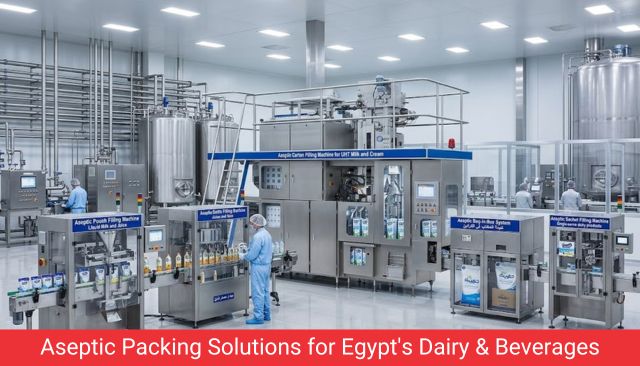
Depending on the product and production scale, Egyptian manufacturers typically use:

  • Aseptic pouch filling machines — for liquid milk, flavoured dairy drinks, and juices in stand-up or pillow pouches
  • Aseptic carton filling machines — for UHT milk, cream, and juices in brick-style cartons
  • Aseptic bottle filling machines — for juices, water, and functional beverages
  • Aseptic bag-in-box systems — for industrial dairy and ingredient supply
  • Aseptic sachet filling machines — for single-serve dairy and beverage products in rural and institutional channels

The choice of machine type depends on target consumers, distribution channel, pack size, and production volume. Many Egyptian manufacturers begin with aseptic pouch systems — which combine relatively lower capital investment with flexibility in pack size — before moving to carton or bottle filling as volumes grow.

Technical Requirements for Aseptic Packing in Egypt

For aseptic packing machines operating in Egyptian conditions, several technical specifications are particularly important:

  • Robust sterilisation systems — H₂O₂ spray or UV sterilisation with validated concentration monitoring, designed to deliver consistent performance despite ambient temperature fluctuations
  • CIP (Clean-in-Place) and SIP (Sterilise-in-Place) systems — enabling thorough automated cleaning without dismantling the machine, essential in environments where manual cleaning standards may vary
  • Power supply resilience — machines with voltage stabilisers, UPS compatibility, and tolerance for power fluctuations are essential for Egyptian factory conditions
  • Stainless steel 304/316L food-contact parts — meeting HACCP and Egyptian Standards Organisation (ESO) hygiene requirements
  • PLC control with HMI and full batch traceability — supporting documentation requirements for domestic regulatory compliance and export certification
  • Servo-driven filling and sealing — for precise fill weight control and consistent seal integrity across high-speed production runs

Market Drivers: Why Now Is the Right Time to Invest

Several factors are converging to make 2025–2026 a particularly compelling moment for Egyptian dairy and beverage brands to invest in aseptic packing technology:

Growing domestic demand for packaged dairy. Egypt’s urbanisation rate is rising, and urban consumers increasingly prefer packaged, branded dairy products over loose or informally packaged alternatives. The shift from bulk to branded packaged dairy creates direct demand for high-quality aseptic filling solutions.

Government food manufacturing incentives. Egypt’s industrial development programmes — including the Egyptian Food Export Council initiatives and the Central Bank’s support for manufacturing investment — provide financial support and subsidised financing for food processing and packaging equipment investment.

Rising export ambitions. Egypt’s government has identified food processing and export as a strategic economic priority. Manufacturers who invest in internationally compliant aseptic packaging will be better positioned to benefit from export promotion programmes and access to Gulf and European markets.

Competition from imports. International dairy brands competing in the Egyptian market use aseptic packaging as a quality signal. Domestic manufacturers who adopt the same technology can compete more effectively on quality perception and shelf life.

Return on Investment: The Business Case for Egyptian Manufacturers

The return on investment for an aseptic packing machine in Egypt can be calculated across several dimensions:

  • Reduced product losses from spoilage during distribution — potentially 5–15% of production value in conventionally packaged dairy
  • Lower logistics cost from reduced cold chain dependency — refrigerated transport in Egypt can cost 3–5x ambient temperature delivery
  • Higher selling price — aseptic packaged dairy commands a premium of 10–25% over fresh packaged equivalents in retail
  • Export revenue — entering Gulf export markets at prices significantly above domestic retail adds substantial top-line value
  • Reduced packaging material waste — aseptic systems typically achieve very low pack reject rates compared to conventional fill-seal lines

Conclusion

Egyptian dairy and beverage brands investing in aseptic packing technology are not simply upgrading their equipment — they are fundamentally transforming their ability to compete, distribute, export, and build enduring consumer brands. The combination of extended shelf life, cold chain independence, food safety compliance, and premium brand positioning makes aseptic packing machines one of the highest-impact capital investments available to a food manufacturer in Egypt today.

As the Egyptian food industry continues to modernise and as export ambitions grow, aseptic packing machine Egypt solutions will move from competitive advantage to industry standard. Manufacturers who make this investment now will be several steps ahead when that transition is complete.

x

Call now

    agree that Steeler will collect my name and email information
    ×