
Fair Pack

Leading Packaging Machinery Manufacturer – Aseptic, VFFS, Multihead Weigher, Auger Filler, Flow Wrap, PFS & Semi-Automatic Machines | Serving India, UAE, Saudi Arabia, Africa, Europe, USA & More

Aseptic Packing Machines in Russia: Cold Chain Challenges and How Aseptic Technology Fills the Gap

Russia presents one of the most challenging and fascinating environments in the world for food and beverage packaging. Spanning eleven time zones and covering nearly 17 million square kilometres, the country’s food distribution infrastructure faces geographic, climatic, and logistical obstacles that are practically unique in scale. For dairy and beverage manufacturers operating across Russia — from Moscow and St. Petersburg to Novosibirsk, Vladivostok, and the vast rural regions of Siberia — cold chain reliability is a constant operational concern. Aseptic packing technology has emerged as one of the most powerful solutions to this challenge, enabling manufacturers to produce shelf-stable, high-quality dairy and beverage products that can be distributed across Russia’s enormous geography without depending on an unbroken refrigerated cold chain.

Russia's Cold Chain: A Structural Challenge

Russia’s cold chain infrastructure has developed significantly in recent decades, particularly in major urban centres. Modern cold stores, refrigerated logistics networks, and chilled retail display are well-established in Moscow, St. Petersburg, Yekaterinburg, and other large cities. However, outside these urban corridors, the cold chain remains fragmented, expensive, and vulnerable to the country’s extreme climatic conditions.

The challenges are both structural and operational:

  • Extreme temperature variation — Russian winters can plunge to -40°C or lower in Siberia and the Far East, creating both opportunities (natural cold storage) and risks (pipe freezing, vehicle failure, power outages). Summers bring high ambient temperatures that accelerate product deterioration if cold chain gaps occur.
  • Geographic distances — transporting dairy or beverage products from a production facility in central Russia to consumers in remote Siberian towns or the Russian Far East may involve thousands of kilometres of road, rail, and even river transport, with limited reliable refrigeration throughout.
  • Energy cost and reliability — operating refrigerated transport and cold storage across Russia is expensive, and power supply reliability varies significantly outside major centres.
  • Infrastructure investment lag — while Russia’s cold chain infrastructure is improving, the pace of improvement has not kept up with the growing demand for packaged, branded, and imported food and beverage products.

These structural realities make the aseptic packing machine Russia context very different from Western Europe or North America, where cold chain infrastructure is dense and highly reliable.

Speak with an Expert
Call Call Us Now!

How Aseptic Packing Technology Addresses Russia's Distribution Challenges

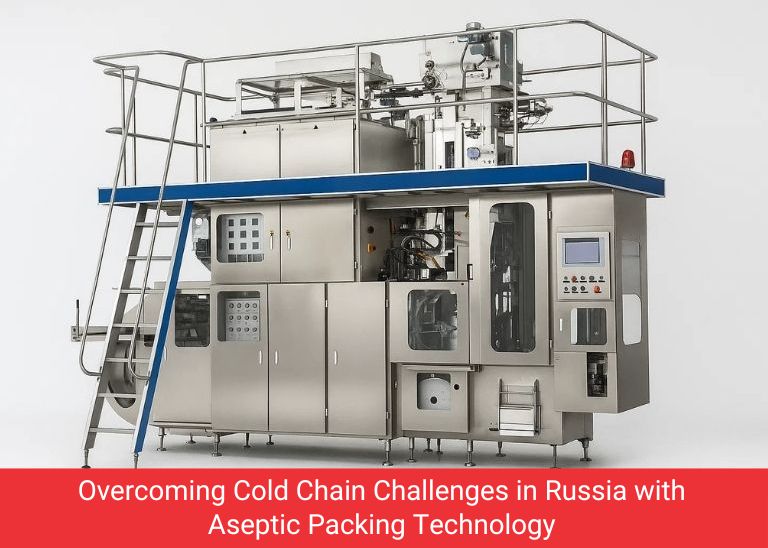
Aseptic packing technology solves the cold chain problem at its root. By sterilising both product and packaging, filling in a sterile environment, and creating a hermetically sealed pack, aseptic systems produce dairy and beverage products that require no refrigeration for storage or transport — and that maintain their quality, safety, and nutritional value for 6 to 12 months at ambient temperature.

For a Russian dairy or beverage manufacturer, this means:

  • Unlimited distribution reach — a UHT milk product packed aseptically can be shipped to any corner of Russia without refrigerated transport, opening markets that cold-chain products simply cannot economically reach
  • Reduced logistics cost — ambient temperature transport is substantially cheaper than refrigerated logistics, particularly over the long distances typical of Russian distribution
  • Lower spoilage and waste — without cold chain dependency, the risk of product loss from temperature abuse during transit is eliminated
  • Simpler retail requirements — ambient shelf display does not require expensive refrigerated cabinet investment, making distribution to smaller towns and rural retailers more commercially viable
  • Supply chain resilience — aseptically packed products can be held in inventory for months, providing a buffer against supply chain disruptions of the kind that have become more common in recent years

The Russian Dairy and Beverage Market

Russia is one of the world’s largest dairy markets. Per capita milk consumption remains high, and the UHT milk segment has grown significantly as consumers and retailers recognise the convenience and safety advantages of ambient shelf-stable dairy. Russia’s domestic dairy industry — producing milk, kefir, ryazhenka, smetana, and a range of dairy drinks — has invested heavily in UHT and aseptic technology over the past two decades, and the installed base of aseptic packing machines in Russia is now substantial.

The beverage sector has similarly embraced aseptic technology for fruit juices, nectars, and functional drinks. Russian consumers have demonstrated strong preference for ambient shelf-stable juices — a preference shaped partly by the practicalities of shopping and storage in a country where transport distances from store to home can be significant.

Key product categories using aseptic packing machines in Russia include:

  • UHT milk — the dominant format for ambient dairy, sold in volumes of 200ml to 1,000ml
  • Dairy drinks and flavoured milk — in aseptic pouches and cartons for retail and institutional channels
  • Fruit juices, nectars, and juice drinks — aseptic carton and bottle filling at high speeds
  • Plant-based dairy alternatives — a growing segment as Russian consumers adopt plant-based diets
  • Soups and broths — ambient shelf-stable liquid foods in aseptic cartons and pouches
  • Functional beverages — protein drinks, vitamin waters, and sports nutrition in aseptic bottles and pouches

Technical Considerations for Aseptic Packing Machines in Russia

Operating aseptic packing equipment in Russia requires careful attention to several technical factors:

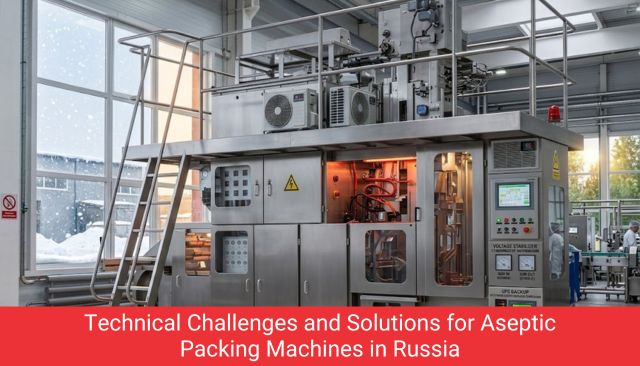
Extreme temperature operation. Factory conditions in Russia, particularly in regions outside the temperate European zone, can involve very low ambient temperatures in winter and high temperatures in summer. Machines must be specified and installed with appropriate thermal management — heating for instrument cabinets in cold conditions, cooling for electrical panels in summer.

Power quality. Russia’s electrical grid, while generally reliable in urban areas, can experience voltage fluctuations and brief outages in more remote industrial locations. Aseptic packing machines must include voltage stabilisers and surge protection, and critical systems should have UPS backup to prevent sterile zone breaches during brief power interruptions.

Spare parts and service. Given Russia’s geographic scale and the complexity of aseptic machinery, robust spare parts availability — including local inventory of critical components — and reliable service support are essential. Manufacturers should specify machines with standard, internationally available components (PLCs, servo drives, sensors) to ensure serviceability.

Water quality. Water used in CIP/SIP cycles must meet specified purity standards. In some Russian industrial locations, water treatment equipment (reverse osmosis, softening) may be required upstream of the aseptic machine.

Stainless steel specification. Given Russia’s varying water chemistry, SS 316L for all product-contact parts and critical wetted surfaces is strongly recommended for long-term corrosion resistance.

Regulatory Context

Russian food safety regulation under the Federal Service for Surveillance on Consumer Rights Protection and Human Wellbeing (Rospotrebnadzor) and the Eurasian Economic Union (EAEU) technical regulations set standards for UHT processing, aseptic packaging, and shelf life claims. Aseptic packing machines must be capable of meeting the sterility and process control documentation requirements of these frameworks, and manufacturers must hold relevant EAEU declarations of conformity for their aseptic products.

Market Outlook and Investment Rationale

Russia’s aseptic packing machine market continues to evolve. Dairy and beverage manufacturers are investing in capacity expansion to meet domestic demand growth and to replace aging equipment with more technically advanced, energy-efficient systems. Import substitution policies following geopolitical changes in recent years have also created renewed interest in machines sourced from Asia — including India, which has emerged as a capable supplier of technically advanced aseptic packing equipment at competitive price points.

For a Russian dairy or beverage manufacturer evaluating a cold chain packaging investment decision, the aseptic packing machine offers a compelling proposition: eliminate the cold chain risk, expand the addressable market, reduce logistics cost, and build a product that can be distributed, stored, and consumed anywhere in one of the world’s most geographically challenging — and opportunity-rich — food markets.

Quick Response Guaranteed
Message us on WhatsApp Email Us Now!

Conclusion

Russia’s cold chain challenges are not going away. Geography, climate, and infrastructure gaps will continue to create risks and costs for dairy and beverage manufacturers who depend on refrigerated distribution. Aseptic packing technology fills this gap with a technically mature, commercially proven solution — producing dairy beverage sterile packaging that is safe, shelf-stable, and distributable across Russia’s entire vast territory without cold chain dependency. For manufacturers who invest in this technology, the rewards are not just operational savings but genuine market expansion — reaching consumers and channels that conventional cold chain products simply cannot serve.

x

Call now

    agree that Steeler will collect my name and email information
    ×