
Fair Pack

Leading Packaging Machinery Manufacturer – Aseptic, VFFS, Multihead Weigher, Auger Filler, Flow Wrap, PFS & Semi-Automatic Machines | Serving India, UAE, Saudi Arabia, Africa, Europe, USA & More

Flow Wrap Packaging in Italy's Food Manufacturing Industry: From Pasta to Pastries

Italy is one of the great food nations of the world. Its food manufacturing industry — rooted in centuries of culinary tradition and operating at genuinely global scale — produces products that are consumed and celebrated across every continent. From the pasta mills of Emilia-Romagna and the confectionery factories of Lombardy to the pastry bakeries of Sicily and the cheese producers of the Po Valley, Italian food manufacturers package millions of products every day. At the heart of many of these packaging lines is the flow wrap machine — a technology that has become as integral to Italian food manufacturing as the products themselves.

Speak with an Expert
Call Call Us Now!

Italy's Food Industry: A World-Class Manufacturing Base

Italy’s food and beverage industry is the country’s second-largest manufacturing sector, generating over €160 billion in annual turnover and employing hundreds of thousands of people. Italy is among the world’s top food exporters, with iconic products — pasta, confectionery, biscuits, olive oil, cheese, cured meats, and bakery goods — commanding premium prices in markets from the United States to Japan, from Australia to the Gulf.

The flow wrap machine Italy market is one of Europe’s most technically demanding. Italian food manufacturers are sophisticated buyers who understand machinery performance in detail, have high expectations for reliability and longevity, and operate in markets where packaging quality is a direct reflection of product quality.

Key food categories where flow wrap packaging plays a central role in Italy include:

  • Pasta — fresh and dry pasta in individual and multi-portion packs
  • Bakery and pastry products — panettone, colomba, sfogliatelle, cannoli shells, and industrial baked goods
  • Biscuits and wafers — among Italy’s highest-volume packaged food categories
  • Confectionery — chocolates, nougat (torrone), hard candies, and seasonal specialty sweets
  • Cheese portions — individual portions of Parmigiano Reggiano, Grana Padano, Pecorino, and fresh mozzarella
  • Fresh pasta and filled pasta — tortellini, ravioli, gnocchi in modified atmosphere packaging
  • Snack bars and cereal products — granola bars, rice cakes, and health snack formats

How Flow Wrap Machines Work in Italian Food Packaging

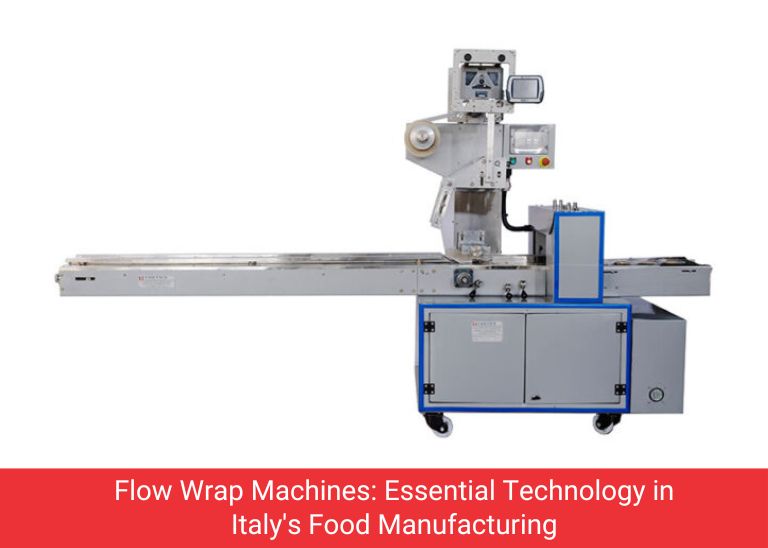
A flow wrap machine — known in Italian industry as a “macchina flow wrapper” or “confezionatrice orizzontale” (horizontal packaging machine) — forms a continuous pillow-shaped or custom-shaped pack around a product using a reel of flat film. The product travels horizontally on a conveyor, is enclosed in the film, sealed longitudinally (fin seal or lap seal), and cut at both ends to create individual packs.

Flow wrappers in Italian food manufacturing are valued for several distinctive capabilities:

High-speed operation. Italian food manufacturers often run very high-volume lines. A biscuit packaging line may need to pack 200–600 biscuits per minute across multiple lanes. A pasta packaging line may need to handle 100–300 packs per minute. Modern servo-driven flow wrappers achieve these speeds with consistent seal quality.

Film versatility. The confectionery flow wrap Italian food market uses an enormous variety of film types — printed OPP, metallised OPP, PET, PE, biodegradable PLA, paper-based films, and cold seal coated films for chocolate. Italian manufacturers are also under increasing regulatory pressure from the EU’s Packaging and Packaging Waste Regulation (PPWR) to adopt more sustainable film materials, making film-flexible flow wrappers increasingly valuable.

Product gentleness. Many Italian food products are fragile — think delicate pastry shells, crisp biscuits, or thin pasta sheets. Servo-driven infeed systems with adjustable speed profiles and product-specific conveyor configurations ensure gentle handling without breakage or product damage.

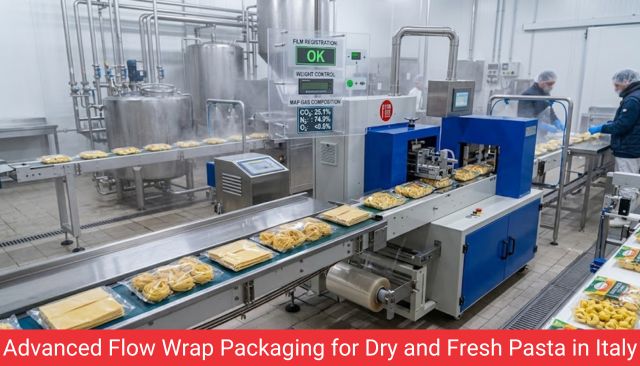
Modified Atmosphere Packaging (MAP). For fresh pasta, cheese, and chilled ready meals, MAP (modified atmosphere packaging) — flushing nitrogen or CO₂/N₂ mixtures into the pack before sealing — is standard. Italian flow wrappers for these applications include gas dosing systems integrated into the forming and sealing section.

Hygienic design. For fresh dairy, pasta, and other moist food products, flow wrappers must meet EHEDG (European Hygienic Engineering and Design Group) standards — with smooth, crevice-free surfaces, open access for cleaning, stainless steel 304/316L product-contact parts, and IP65 or higher electrical protection for washdown environments.

Pasta Packaging in Italy: A Technical Deep Dive

Pasta packaging is one of the most technically interesting flow wrap applications in Italy. The country produces both dry pasta (pasta secca) and fresh pasta (pasta fresca) — each with different packaging requirements.

Dry pasta is typically packed in bags or boxes, but individual nest portions — lasagne sheets, papardelle nests, and specialty pasta formats — are often flow-wrapped in individual packs. The requirements are straightforward: accurate weight (Italian legal metrology regulations apply), hermetic sealing to maintain freshness, and accurate printed film registration for attractive presentation.

Fresh pasta — tortellini, ravioli, tagliatelle — requires MAP with CO₂/N₂ atmosphere to extend shelf life from days to several weeks without refrigeration, or to extend chilled shelf life. Fresh pasta flow wrappers operate in cold, humid environments (the pasta itself is often chilled at 4°C) and must be built with full hygienic design and washdown capability. Accurate gas dosing systems ensure consistent MAP composition, and seal integrity is verified through in-line leak detection.

Filled pasta (pasta ripiena) — containing cheese, meat, or vegetable fillings — presents additional hygiene challenges because the filling may contain meat, allergens, and high-moisture ingredients. CIP capability and strict sanitary design are essential.

Bakery and Pastry Packaging: The Italian Tradition Meets Modern Technology

Italy’s artisan and industrial bakery sector produces some of Europe’s most distinctive baked goods — and the packaging of these products is both a practical and a brand challenge. Panettone, the iconic Milanese Christmas bread, is traditionally packed in decorative bags. Cannoli shells, sfogliatelle, and other regional pastries are delicate, irregular, and often high-value.

For industrial bakery manufacturers, flow wrap machines provide the speed and consistency needed for retail packaging at scale. For artisan bakeries moving from manual to automated packaging, entry-level servo flow wrappers offer a manageable investment with significant labour savings.

Key requirements for Italian bakery packaging include:

  • Moisture barrier performance — bakery products are sensitive to humidity and require films with adequate MVTR (moisture vapour transmission rate) to maintain freshness
  • Nitrogen flushing — for products susceptible to oxidation (particularly those with high fat content, like buttery pastry)
  • Attractive presentation — Italian consumers and export markets associate packaging aesthetics with product quality; precise film registration for printed packs is non-negotiable
  • Variety of pack formats — from single-serve pastries to multi-portion family packs, requiring quick electronic changeover between SKUs

Confectionery Flow Wrap: Chocolate, Nougat, and Seasonal Specialties

Italy is famous for its confectionery traditions — Ferrero, Baratti & Milano, Venchi, and countless regional producers make chocolates, torrone, and specialty sweets that are sold domestically and exported worldwide. The confectionery flow wrap Italian food market has specific requirements:

Cold seal technology is essential for chocolate products. Heat sealing would melt chocolate or cause bloom — cold seal films, activated by pressure rather than heat, create strong hermetic seals without any temperature damage. Italian chocolate manufacturers specify cold seal flow wrappers as standard for enrobed products.

High-speed multi-lane systems are used for individual chocolate pieces and small confectionery items, where twin-lane or quad-lane flow wrappers run at 600–1,500 pieces per minute.

Seasonal products — Easter eggs, Christmas specialty items, regional festive confectionery — require packaging lines that can be reconfigured quickly for different product formats and pack sizes without long downtime.

Regulatory Context: EU Packaging and Sustainability

Italian food manufacturers operate under EU packaging regulations, including the evolving Packaging and Packaging Waste Regulation (PPWR). Requirements for recyclable, compostable, or recycled-content packaging materials are creating pressure on flow wrap machine operators to upgrade or reconfigure their equipment for sustainable film handling. Modern servo-driven flow wrappers with adjustable sealing parameters and film tension control are better positioned to handle the transition to sustainable films than older cam-driven machines.

Quick Response Guaranteed
Message us on WhatsApp Email Us Now!

Conclusion

The flow wrap machine is woven into the fabric of Italy’s food manufacturing industry. From the pasta factories of Bologna to the confectionery halls of Turin, from the bakeries of Naples to the cheese dairies of Parma, horizontal packaging machines deliver the speed, precision, hygiene, and versatility that Italian food production demands. As the industry navigates sustainability transitions, export market requirements, and the enduring pressure to improve efficiency, investment in the right flow wrapper — technically advanced, film-flexible, and built for Italian food quality standards — is one of the most valuable decisions a food manufacturer can make.

x

Call now

    agree that Steeler will collect my name and email information
    ×