
Fair Pack

Leading Packaging Machinery Manufacturer – Aseptic, VFFS, Multihead Weigher, Auger Filler, Flow Wrap, PFS & Semi-Automatic Machines | Serving India, UAE, Saudi Arabia, Africa, Europe, USA & More

Powder packaging looks simple from the outside, yet every product behaves differently at the filling head. A Semi Automatic Auger Filling Machine measures powder by rotating a screw shaped auger inside a hopper, drawing a fixed volume of product with every turn and depositing it into a pouch, pack or container. The accuracy of this process depends heavily on how the auger is configured.

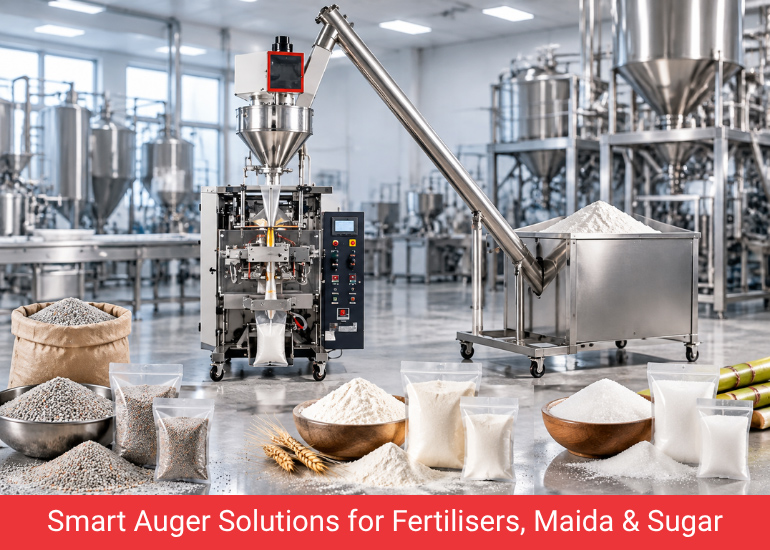
Fertilisers, maida and sugar are three of the most common products packed on auger fillers, and each poses a different challenge. Fertiliser granules can be abrasive and moisture sensitive. Maida is fine, light and prone to clumping. Castor sugar and fine sugar vary in density and can flow unevenly if the auger is not matched to the product. Businesses evaluating a Fertilisers Packing Machine, a Maida Pouch Packing Machine or a Sugar Pouch Filling Machine should understand that these are not separate machine categories, but applications of the same core auger filling technology, adjusted through auger diameter, pitch, rotation speed and hopper design.

This article explains how powder characteristics influence auger selection and what buyers should check before choosing.

Why Auger Configuration Matters in Powder Filling

A Semi Automatic Auger Filling Machine works on a simple principle. The auger, a rotating screw fitted inside or below the hopper, carries a set volume of powder with each rotation and releases it once the required weight is reached. Based on product characteristics and auger configuration, the number of rotations influences the delivered fill volume and final weight.

An auger sized for a light, fluffy powder will not deliver the same fill weight with a denser product without recalibration. Product flow into the auger chamber, how powder settles in the hopper, and the relationship between auger design and bulk density together determine whether the machine holds a steady, repeatable weight across a full production run.

Instant WhatsApp Support
Message us on WhatsApp Chat Now!

Understanding Powder Characteristics Before Selecting an Auger

Before selecting an auger configuration, it helps to understand how the product itself behaves.

  • Fine powders pack densely and can resist even flow, while coarse powders flow more freely but occupy more volume per gram.
  • Bulk density determines how much product a fixed auger volume delivers, so similar looking powders can need different settings.
  • Flowability affects how consistently powder enters the auger chamber from the hopper.
  • Particle size influences how evenly the auger fills its flights during each rotation.
  • Moisture content and cohesiveness can cause powder to bridge or clump inside the hopper, interrupting steady feed.
  • Product behaviour inside the hopper, including settling and aeration, should be observed before finalising auger dimensions.

These factors explain why a configuration suited to one powder may not work equally well with another.

Selecting an Auger Filler for Fertiliser Products

Fertiliser powders and fine granules often combine variable particle size with moisture sensitivity, making auger selection an important part of a Fertilisers Packing Machine setup. Many fertiliser formulations are also chemically corrosive, so contact parts need evaluation for the specific product rather than being assumed suitable across all fertiliser types. Material selection depends on the product’s chemical properties and corrosion risk.

Dust generation is another practical concern, and hopper design along with dust control arrangements help maintain a cleaner filling area. Fertiliser packs are often sold across a range of sizes, from small retail pouches to larger bulk bags, so the configuration should hold accuracy across the intended range rather than a single fixed weight.

Auger Filling for Maida and Flour-Based Products

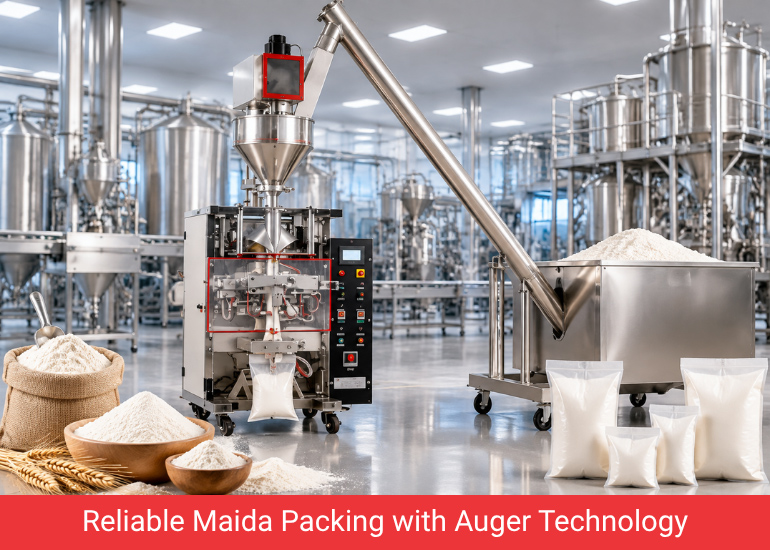
Maida and other flour based products are fine and relatively light, making flowability the central consideration for a Maida Pouch Packing Machine configuration. Flour can aerate easily and settle unevenly in the hopper, sometimes leading to inconsistent dosing if the auger pitch and rotation speed are not matched to the product. A configuration tuned for maida typically focuses on steady, controlled feed into the auger chamber to avoid overfilling or underfilling between cycles.

Dust reduction also matters for flour handling, both for product loss and a cleaner environment. For businesses packing maida in small and medium batch quantities, a Semi Automatic Auger Filling Machine configured for this product maintains pouch filling accuracy without the complexity of a fully automated line.

Choosing an Auger System for Sugar Powder and Fine Sugar

Castor sugar and fine sugar behave differently from both fertilisers and flour, which is why a Sugar Pouch Filling Machine needs its own auger configuration rather than reused settings from another product. Sugar density can vary between batches depending on crystal size and moisture, and this density variation directly affects how much product is delivered per auger rotation. Flow characteristics also differ from flour, since sugar tends to move more freely but can still pack unevenly if the auger pitch is not suited to the crystal size.

The goal in sugar packing is consistent pouch weights with minimal product giveaway, meaning the machine should not routinely overfill packs to stay within tolerance. Correct auger sizing and rotation speed, matched to the specific sugar grade being packed, helps keep fill weights close to target across a production run.

How Auger Diameter and Pitch Affect Filling Accuracy

Auger screw diameter and pitch determine how much powder the screw carries with each rotation. A larger diameter or wider pitch moves more product per turn, which suits coarser or free flowing powders, while a smaller diameter or tighter pitch offers finer control for lighter or more cohesive products. Rotation speed works alongside diameter and pitch to set the product feed rate.

Faster rotation increases throughput but can reduce accuracy with fine powders if hopper feed cannot keep pace, while slower rotation improves control but reduces speed. Fine and coarse products therefore call for different combinations of diameter, pitch and speed, matched to the powder being packed.

Semi-Automatic vs. Automatic Auger Filling for Different Production Volumes

Operator assisted, semi automatic auger filling suits businesses running small batch or medium scale production, where an operator places pouches or containers under the filling head and manages the packaging cycle. This approach offers flexibility for handling multiple products or pack sizes without reconfiguring an entire line.

Automatic auger filling systems reduce manual involvement and increase production speed, which becomes relevant as volumes grow and labour requirements start to limit output. The right choice depends on production volume, product variety and how much manual handling the operation can sustain. Many businesses start with a semi automatic setup and upgrade to automatic packaging once volume and consistency needs justify the investment.

Choosing the Correct Filling Range for Different Powder Products

Filling range depends on the product and the intended pack size. Common ranges used across powder packaging include:

Filling Range

Typical Use Case

Considerations

10g to 1kg

Small retail pouches, sachets

Fine dosing control

1kg to 2kg

Standard retail packs

Speed and weight consistency

2kg to 5kg

Household or catering packs

Hopper capacity

5kg to 10kg

Bulk or industrial packs

Higher volume per cycle

These ranges are categories for evaluating machinery requirements, not a guarantee a single machine covers every range. Fair Pack Machineries’ auger packing equipment is offered for filling requirements spanning approximately 10 grams to 10 kilograms, and the exact configuration should be confirmed against the specific product and pack size needed.

Pouch Compatibility and Integration with Packaging Equipment

Auger filling is only one part of the packaging line. Maida pouch packaging, sugar pouch filling and fertiliser bag or pouch filling all need to align with the pouch format being used, whether that is a pillow pouch or a three side sealed pouch.

The auger filling machine also needs to work smoothly with the rest of the line, including conveyors that move product to and from the filling station and sealing systems that close the finished pack. Fair Pack Machineries offers auger filling machines alongside conveyors and sealing equipment, integrating the filling stage into a complete packaging setup rather than a standalone unit.

We’re Just a Call Away
Contact Now!

Key Factors to Check Before Buying a Semi Automatic Auger Filling Machine

Before finalising a purchase, review these factors against the product:

  • Product characteristics, including particle size, density, flowability and moisture content
  • Required filling range for the pack sizes being produced
  • Accuracy requirements for the product and industry
  • Auger configuration, including diameter, pitch and rotation speed
  • Hopper capacity relative to production batch sizes
  • Contact material requirements, particularly for corrosive or sensitive products
  • Current production volume and expected throughput
  • Future product flexibility, in case the line needs to handle additional powders later

Reviewing these points against the specific product makes selecting a well performing configuration easier.

Conclusion

Choosing the right Semi Automatic Auger Filling Machine configuration comes down to understanding the powder being packed. Particle size, bulk density, flowability, moisture content, cohesiveness and the required filling range all influence how the auger should be set up. Auger diameter, screw pitch, rotation speed, hopper design, contact materials, dust control, packaging format and production volume together determine how well a machine performs across fertilisers, maida and fine sugar. A configuration that works well for one product will not necessarily suit another without adjustment.

Fair Pack Machineries supports manufacturers working through these decisions, offering auger filling machines, conveyors and sealing equipment that can be configured for different powder products and integrated into a complete packaging line based on the specific requirements of the operation.

x

Call now

    agree that Steeler will collect my name and email information
    ×