
Fair Pack

Leading Packaging Machinery Manufacturer – Aseptic, VFFS, Multihead Weigher, Auger Filler, Flow Wrap, PFS & Semi-Automatic Machines | Serving India, UAE, Saudi Arabia, Africa, Europe, USA & More

Pickles Packing Machine: How Multitrack Systems Handle Chunky, Liquid-Heavy Products

The Complex World of Pickle Packaging

Indian pickles are among the most beloved and commercially significant condiment products in the country’s food culture. From the sharp, spicy mango pickle of North India to the tangy lemon pickle of Gujarat, from the mustard oil-based mixed vegetable pickle of Bihar to the dry coconut pickle of South India, the Indian pickle market encompasses an extraordinary diversity of regional preparations, each with its own texture, viscosity, particle size profile, and packing requirements. The Indian pickle market, including both traditional achar and modern branded pickle products, is valued at several thousand crore rupees and is growing steadily as branded packaged formats displace traditional home-made and loose market purchases.

Packing pickles efficiently, hygienically, and accurately is significantly more technically demanding than packing most other food products. Pickles are not a simple paste or a simple liquid. They are complex multi-phase systems containing solid vegetable or fruit pieces of irregular size and shape, surrounded by oil or brine at varying proportions, often with whole spice inclusions, and with a consistency that ranges from a liquid-heavy mango brine to a chunky mixed vegetable pickle to an almost-dry lime pickle. Understanding these complexities and how modern multitrack packaging machines address them is essential for any pickle producer planning a packing line investment.

The Specific Challenges of Pickle Packing

Solid Inclusions and Large Particles

The most immediately obvious challenge in pickle packing machine design is the solid piece content of the product. Whole or halved mango pieces, large onion quarters, chunks of carrot, turnip, or cauliflower, and whole garlic pods are common components of Indian pickle varieties. A fill head for a pickles packing machine must have an aperture large enough to pass the largest solid pieces in the product without choking or causing jamming at the fill nozzle. This requirement conflicts directly with the need for a tight anti-drip cut-off at the end of each fill cycle: a nozzle large enough to pass large pieces is inherently more difficult to close cleanly.

Modern pickle packing machine designs address this challenge through large-bore piston filler mechanisms with specialised spring-loaded anti-drip cut-off designs that can close cleanly even when a piece of vegetable is crossing the nozzle aperture at cut-off time. The machine must be designed to detect and handle the occasional piece that bridges or blocks the nozzle without causing extended production downtime.

Call Now for Instant Assistance!
Call Call Now

Oil and Brine Separation

Many Indian pickles are oil-based, with mustard oil, sesame oil, or refined oil as the carrying medium. Oil-based pickles present a packaging challenge because the oil and solid phases have different densities and will separate if the product is allowed to stand without agitation. A pickle packing machine that fills from a static holding tank may deliver sachets or pouches that are either oil-heavy or solid-heavy depending on where in the production run they are filled. Continuous agitation of the product holding tank using a slow stirrer or recirculation pump is essential to maintain product homogeneity throughout the production run.

Brine-based pickles including lime pickle, raw mango pickle in brine, and some South Indian pickle varieties present a similar separation challenge. The brine liquid phase settles below the solid phase in a static tank. Maintaining consistent product distribution in the fill requires continuous agitation and appropriate fill head positioning.

Oil Contamination of Sealing Surfaces

Oil-based pickles present a specific sealing challenge that is unique to this product category. Mustard oil and other vegetable oils are among the most difficult products to seal reliably in flexible film sachets because even a small amount of oil contamination on the seal area prevents the heat-activated adhesive on the inner film surface from bonding. A pickles pouch packing machine must incorporate an anti-drip nozzle design that eliminates oil deposition on the seal area, combined with a sealing jaw temperature and pressure profile that is capable of forming hermetic seals even when small amounts of oil contamination are present. This requirement typically means using a higher sealing jaw temperature than would be used for non-oily products, combined with extended dwell time.

Acidic and Corrosive Product Nature

Indian pickles are highly acidic products, with pH values that can be as low as 2.5 to 3.5 for lime and raw mango varieties. This acidity is corrosive to metals and can cause rapid deterioration of machine components that are not specified for acid resistance. All product-contact surfaces in a pickles packing machine must be in food-grade stainless steel of an appropriate grade that resists the acidic, salty, and oily environment of Indian pickle products. Fasteners, seals, and non-contact components that are exposed to oil or brine vapour must also be specified for the corrosive environment.

How Multitrack Technology Applies to Pickle Packing

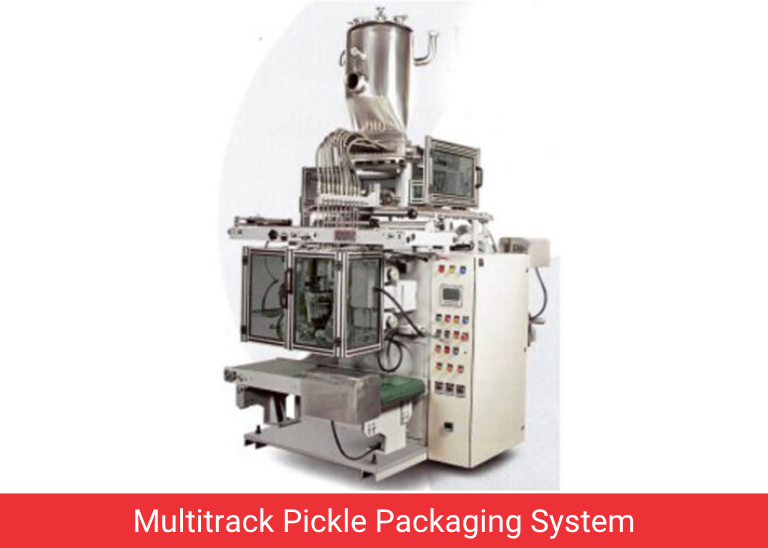
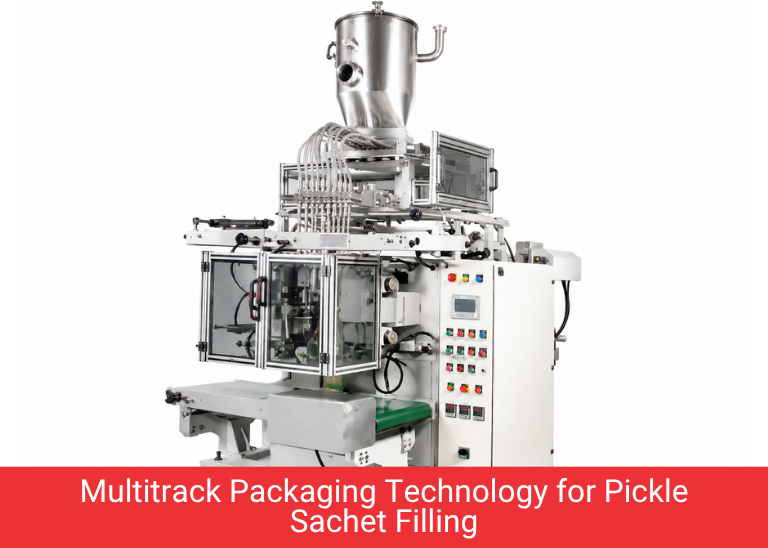
The multitrack packaging machine is increasingly used for pickle sachet production, particularly for the small and medium-sized sachets that are used in food service, hotel amenity packs, airline meals, and retail multipacks. A multitrack FFS machine for pickle packing must be specifically configured for the product’s characteristics, which differ significantly from the standard powder or liquid sachet applications for which multitrack machines are more commonly used.

For pickle sachet production, the multitrack packaging machine is configured with large-bore piston fill heads in place of auger fillers, a shared heated and agitated product holding system that maintains product homogeneity and temperature throughout the production run, product-specific anti-drip nozzle designs with sealing-grade cut-off performance, and a film sealing system that is configured for the higher sealing temperatures and dwell times required for oil-contaminated seal areas. The production speed of a multitrack pickle packing machine for small sachets typically ranges from 200 to 600 sachets per minute depending on sachet size and product characteristics, which is commercially appropriate for the high-volume food service and retail sachet market.

Pouch and Jar Format Pickle Packing

Not all pickle packaging is in sachet format. Consumer retail packs of pickle in glass jars, PET jars, and flexible stand-up pouches represent the dominant formats for the organised branded pickle market in India. Pickle bottle sealing machine configurations and jar filling machines for pickle must accommodate the specific combination of solid pieces and liquid oil or brine that characterises Indian pickle products.

Pickle jar filling machines use piston filler mechanisms with large-bore nozzles and product recirculation systems. The jar sealing machine configuration must apply appropriate torque for reliable hermetic sealing without breaking the jar. A small pickle packing machine for artisan or regional pickle brands may be a semi-automatic piston filler with manual jar placement, which provides affordable entry into mechanised pickle packing without the capital investment of a fully automatic system.

Film Selection for Pickle Sachets

The packaging film used in a pickles pouch packing machine or multitrack pickle sachet machine must provide several performance characteristics simultaneously. It must have adequate moisture and oxygen barrier to protect the pickle’s flavour and colour during shelf life. It must be resistant to penetration by the oils used in the product, which some lower-specification laminated films are not. It must provide adequate seal strength for the sachet format, particularly given the weight of oil-heavy pickle products. And it must be compatible with the higher sealing temperatures required to achieve hermetic seals on oil-contaminated film surfaces. Film selection for pickle packing should always be reviewed with the film supplier and the machine manufacturer before a production run is commenced.

Cleaning Requirements for Pickle Packing Machines

The combination of oil, acid, salt, and solid particles that characterises Indian pickle products makes cleaning of pickle packing machines a particularly important operational requirement. Oil deposits harden on hot surfaces and are difficult to remove without appropriate cleaning agents. Acidic brine is corrosive to sealing system components and must be neutralised and flushed thoroughly at the end of each production run. Solid pieces that enter the fill head mechanism and are not removed during cleaning can become a source of contamination in subsequent production runs. A pickles packing machine from Fair Pack Machineries is designed with full tool-free disassembly of product-contact components, smooth internal surfaces without dead zones, and materials specified for cleaning with the alkali and acid cleaners appropriate for oil and acid residues.

Fair Pack Machineries Pickle Packing Solutions

Fair Pack Machineries offers paste packaging machines, piston fillers, and multitrack packaging machines that are suitable for pickle packing applications in both sachet and pouch formats. The company’s experience in designing filling systems for paste, semi-liquid, and inclusion-heavy food products, combined with the hygienic design standards it applies across its full product range, makes it a knowledgeable and capable supplier for pickle producers at every scale. Fair Pack’s technical team works directly with pickle producers to understand their specific product characteristics, production volumes, and format requirements before recommending a machine configuration, ensuring that the investment is optimally matched to the operational reality of pickle packing in India.

We are Fast in Response
Contact Now!

Conclusion

Pickle packing is one of the most technically demanding applications in the Indian food packaging machinery market. The combination of solid inclusions, oil or brine liquid phase, high acidity, and oily seal area contamination creates a set of machine design requirements that goes well beyond standard paste or liquid packing machine specifications. Modern multitrack packaging machines and piston filler systems designed specifically for Indian pickle products address these challenges through large-bore fill heads, continuous product agitation, anti-drip oil-resistant nozzle designs, enhanced seal system specifications, and acid-resistant stainless steel construction. Fair Pack Machineries invites pickle producers, condiment manufacturers, and food service supply companies to discuss their pickle packing requirements and identify the right machine configuration for their specific product range and production scale.

x

Call now

    agree that Steeler will collect my name and email information
    ×