
Fair Pack

Leading Packaging Machinery Manufacturer – Aseptic, VFFS, Multihead Weigher, Auger Filler, Flow Wrap, PFS & Semi-Automatic Machines | Serving India, UAE, Saudi Arabia, Africa, Europe, USA & More
Honey Filling Machine Practical Buying Guide Jars Bottles Pouches Sachets

Honey Filling Machine: 7 Key Factors to Consider Before Buying (2026 Guide)

A practical buying guide to choosing the right honey filling machine and honey packing machine for jars, bottles, pouches and sachets:

A honey filling machine, often referred to as a honey packing machine, is precision equipment built to measure, dispense and pack honey into jars, bottles, pouches or sachets without compromising its purity, texture or shelf life. As global honey consumption and private-label honey brands continue to grow through 2026, more apiaries, contract packers and FMCG processors are investing in dedicated filling equipment instead of relying on manual ladling and weighing. But honey is one of the most technically demanding liquids to package: it is highly viscous, temperature-sensitive and prone to crystallization, which means a filler designed for water, oil or sauce will rarely perform well with honey straight out of the box.

Choosing the wrong honey filling machine leads to inconsistent fill weights, product wastage, messy drips, hygiene non-compliance and frequent breakdowns that stall production. Whether you run a small apiary scaling into retail, a contract packaging unit serving multiple honey brands or a full FMCG bottling line, the right honey packing machine should align with your production volume, container format, budget and long-term growth plans. This 2026 guide breaks down the seven key factors that matter most before you buy a honey filling machine, so you can evaluate suppliers with confidence and avoid costly mistakes.

Call Now for Quick Support
Call Call Now

Honey Packing Machine Viscosity Handling: Match the Machine to Your Honey's Thickness

Honey is one of the most viscosity-variable liquids in food packaging. Its thickness shifts with temperature, moisture content and floral source and most raw or unprocessed honey crystallizes at room temperature within weeks or months. Before buying a honey filling machine, study how your honey behaves across seasons and storage conditions, because equipment calibrated only for warm, free-flowing honey will struggle once batches turn cold or partially crystallized. Look for adjustable fill speed and pressure settings and ideally a heating jacket or double-layer insulated hopper that keeps honey flowing smoothly without overheating it, since excess heat above roughly 60°C can damage enzymes and aroma compounds. Piston-based and auger-based mechanisms generally handle thick, viscous honey far better than simple gravity fillers, which depend on flow rate alone and slow down sharply as viscosity rises. If your range spans creamed, raw and liquid honey, prioritize a honey packing machine that lets you reconfigure these settings quickly between batches rather than buying separate machines for each consistency.

Honey Filling Machine Type: Piston, Volumetric, Auger or Gravity Filling Explained

Not every honey filling machine uses the same dosing principle and the technology behind it directly affects accuracy, speed and suitability for thick products. Gravity fillers are the simplest and most affordable option, relying on honey’s own weight to flow through a nozzle and they work best with warmed, thinner honey and lower output needs. Piston fillers use a calibrated cylinder to draw and push out a fixed volume under pressure, making them well suited to thick, viscous honey that will not flow on its own. Volumetric and weighmetric (weight-based) fillers measure honey by a set volume or weight, giving excellent repeatability for jars and bottles where declared net weight accuracy matters for legal compliance. Servo auger fillers, more commonly used for powders, can also be adapted to dose thick pastes and honey blends with tight control. When comparing suppliers, ask exactly which filling principle its honey filling machine uses, how it performs with honey specifically rather than water or oil and whether nozzles include a suck-back or anti-drip valve to stop stringing and post-fill drips.

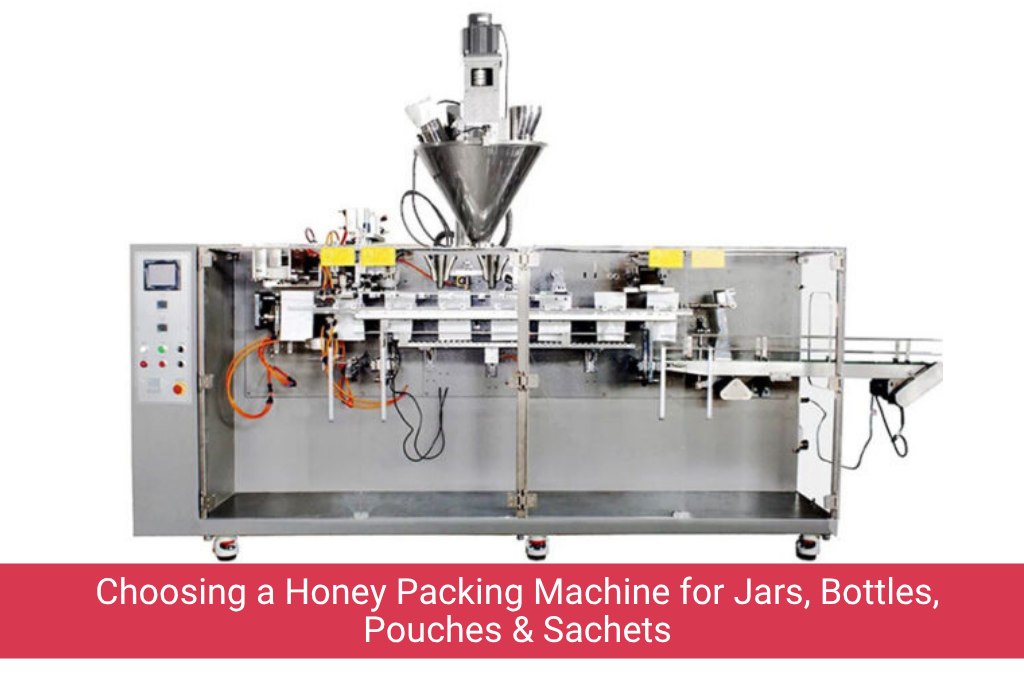
Choosing Honey Packing Machine for Jars, Bottles, Pouches, and Sachets

Honey Packing Machine Container Compatibility: Jars, Bottles, Pouches and Sachets

Your packaging format should shape your machine choice, not the other way around. Glass and PET jars typically have wider openings and can tolerate stronger filling pressure, making them compatible with most piston and volumetric honey filling machines on the market. Bottles, especially squeeze bottles with narrow necks, need careful nozzle design to avoid air bubbles, foaming or splashing during the fill cycle. Pouches, sachets and honey sticks call for a different approach entirely; these formats benefit from a suck-back mechanism that pulls a small amount of honey back into the nozzle after each dose, preventing leakage and ensuring a clean seal at the pouch mouth. If your business sells honey across multiple formats or plans to expand into single-serve sachets alongside traditional jars, choose a honey packing machine with interchangeable nozzles, adjustable fill heads and fast changeover capability. This versatility protects your investment as your product line grows, rather than forcing a fresh equipment purchase every time you add a new container size or shape.

Honey Filling Machine Automation Level: Semi-Automatic vs. Fully Automatic Production

Automation level is usually the single biggest factor shaping both cost and output. Semi-automatic honey filling machines need an operator to place and remove containers manually while the machine handles dosing, making them well suited to small apiaries, artisan brands and operations filling a few thousand units or fewer per day. Fully automatic honey packing machines integrate container infeed, filling, capping and often labeling into one continuous line, sharply increasing throughput for businesses filling tens of thousands of units daily, though at a noticeably higher upfront cost. As a general rule, fully automatic systems lower long-term labor costs and improve consistency, while semi-automatic machines offer more flexibility to switch between formats and need less operator training. Map your current daily or monthly output against realistic growth projections for the next three to five years before deciding; many honey brands start with a dependable semi-automatic filler and later add conveyors and automation modules in stages, rather than committing to a fully automatic line on day one.

Honey Packing Machine Hygiene and Material Standards: Food-Grade Compliance Matters

Because honey is consumed directly, every honey-contact surface on your filling machine must be easy to clean, corrosion-resistant and free of crevices where residue or bacteria could collect. Food-grade stainless steel, typically SS304 or SS316, is the industry standard for hoppers, pump heads, nozzles and pipework, since it withstands the acidic and alkaline cleaning agents used in routine sanitation. Check whether the pump head can be disassembled quickly for cleaning; machines with welded or permanently sealed components that trap water and product residue create contamination risk and slow down changeovers between honey batches. For export-oriented businesses, look for compliance with recognized hygienic-design frameworks, since many international buyers and retailers expect documented proof of food-safe construction before placing orders. A honey filler machine built to these standards protects consumer health and shields your brand from costly recalls, rejected shipments or failed quality audits.

Honey Filling Machine Accuracy and Fill Consistency: Protecting Margins and Brand Trust

Fill accuracy directly affects your bottom line and your standing with customers and regulators. Overfilling, even by a small margin per unit, adds up to significant product loss across thousands of containers, while underfilling risks consumer complaints, retailer rejections and non-compliance with legal metrology rules governing declared net weight on packaged goods. Look for a honey filler with adjustable, repeatable dosing accuracy, ideally backed by a digital or PLC control panel that lets you save fill profiles for different products and container sizes. Anti-drip nozzles and shut-off valves matter just as much as the core filling mechanism, since honey’s tendency to string and drip can leave messy, unsellable jars even when the dosed volume itself is correct. If you sell honey by declared weight rather than volume, ask whether the machine supports weighmetric filling or integrates with an external calibrated scale, since weight-accuracy regulations in many countries call for traceable, calibrated verification rather than a built-in display alone.

Honey Packing Machine Total Cost of Ownership: Support, Spares and Long-Term ROI

Honey filling machine cost is only the starting point of your real investment. Total cost of ownership includes spare-part availability, routine maintenance, energy use, operator training and how quickly the manufacturer responds when something breaks down mid-production. A cheaper machine that lacks accessible seals, pistons or nozzles can cost far more over its lifetime through downtime and product waste than a slightly pricier model backed by strong after-sales support. Before you buy, ask suppliers directly how quickly replacement parts can be sourced, whether on-site or remote technical support is available and whether the manufacturer has an established track record with food and beverage clients in your region. Manufacturers with decades of experience, a wide installed base and export relationships across multiple countries are generally better positioned to support your honey fill machine for its full service life, instead of leaving you stranded with an unsupported import once the warranty period ends.

Inquire Now for More Information
Contact Us

Fair Pack Machineries Supports Honey Packing Machine Decision

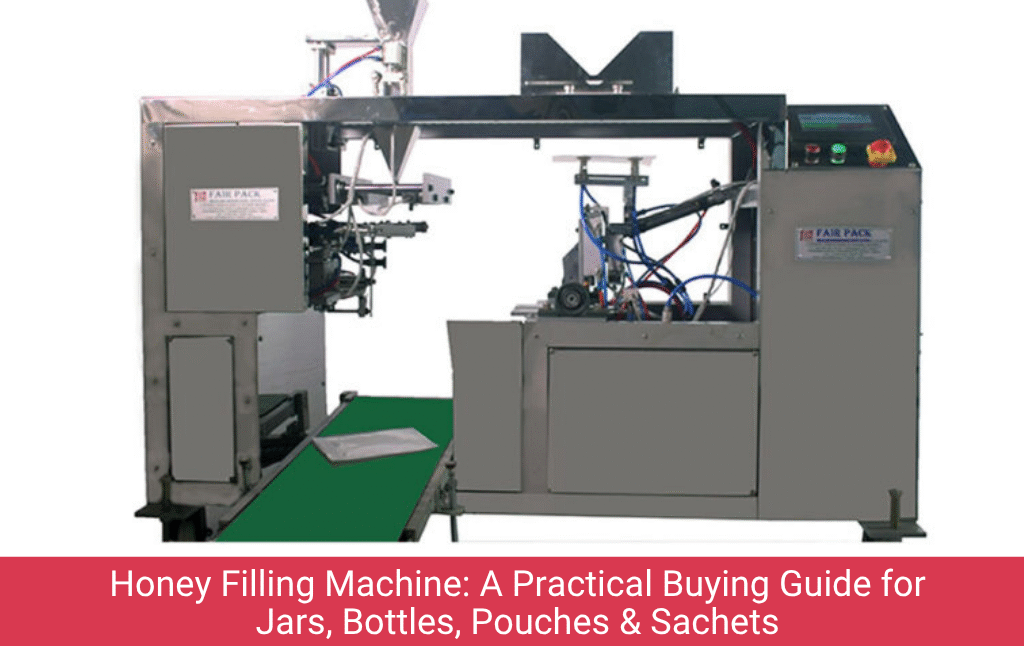
Fair Pack Machineries, a Chennai-based packaging machinery manufacturer with over two decades of experience since 1998, designs filling and packing systems that map directly onto the seven factors above. Its filling systems range includes Liquid Packing Machine, Auger Packing Machine, Flow Wrap Packing Machine, Volumetric Packing Machine and Semi-Automatic Weighmetric Filling Machines, engineered to handle viscous, food-grade products such as honey, paste and oil without compromising accuracy or hygiene. Every honey-contact component is built from food-grade stainless steel and designed for quick disassembly and cleaning, supporting the hygiene standards covered in this guide.

Businesses can start with a semi-automatic configuration suited to a growing apiary or artisan honey brand, then scale into an integrated line by adding conveyor systems, including flat belt, roller and bucket conveyors, as volumes increase. With installations across India, the UAE, Saudi Arabia, Europe, Africa, the Americas and beyond, Fair Pack Machineries backs its honey packing machine solutions with consultation, custom configuration and ongoing maintenance support, rather than a one-time sale.

Our Other Products

8-Station Rotary PFS Machine

Conclusion

Choosing the right honey filling machine ultimately comes down to matching the equipment to your honey’s viscosity, your container format, and your production scale rather than chasing the cheapest or fastest option. Hygiene-compliant materials and accurate, repeatable fills protect both your brand and your margins over time. As your business grows, a versatile honey packing machine with strong after-sales support delivers far better long-term value than a rigid, unsupported one. With the right partner, such as Fair Pack Machineries, one can scale confidently from a semi-automatic setup to a fully integrated production line.
To explore filling and packing systems suited to your honey production scale and container format, visit https://www.fairpack.in/  

x

Call now

    agree that Steeler will collect my name and email information
    ×