
Fair Pack

Leading Packaging Machinery Manufacturer – Aseptic, VFFS, Multihead Weigher, Auger Filler, Flow Wrap, PFS & Semi-Automatic Machines | Serving India, UAE, Saudi Arabia, Africa, Europe, USA & More

Honey Packing Machine for Pouches, Jars and Sachets: Which Format Suits Your Market?

Format Is Strategy in Honey Packaging

The honey packing machine investment decision is inseparable from a prior and equally important decision: which packaging format is right for your market, your brand positioning, your distribution channel, and your customer base? A honey producer who makes the right packaging format choice and then invests in the right honey filling machine for that format will have a commercially effective, operationally efficient packaging operation. A producer who selects the wrong format for their market, or the wrong machine for their format, will face commercial underperformance or operational difficulties that are difficult and expensive to correct.

Honey is sold in three primary packaging formats in the Indian and global market: pouches including stand-up pouches and flat pouches, rigid containers including glass jars and PET or HDPE bottles, and sachets for single-serve applications. Each format serves different market segments, different price points, different distribution channels, and different consumer occasions. Understanding the commercial logic of each format and the honey packing machine technology that each requires is the essential foundation for a sound packaging investment decision.

Honey in Pouches: The Mass Market Volume Format

The Commercial Case for Pouch Honey

The pouch format is the dominant format for honey in the Indian mass market. Stand-up pouches and flat pouches in sizes from 100 grams to 1 kilogram offer the most competitive cost per unit of packaging material relative to rigid containers, making them the preferred format for producers targeting the price-sensitive mainstream consumer segment. Pouch honey is particularly common in modern trade and online retail, where shelf display and storage efficiency favour the flexible format.

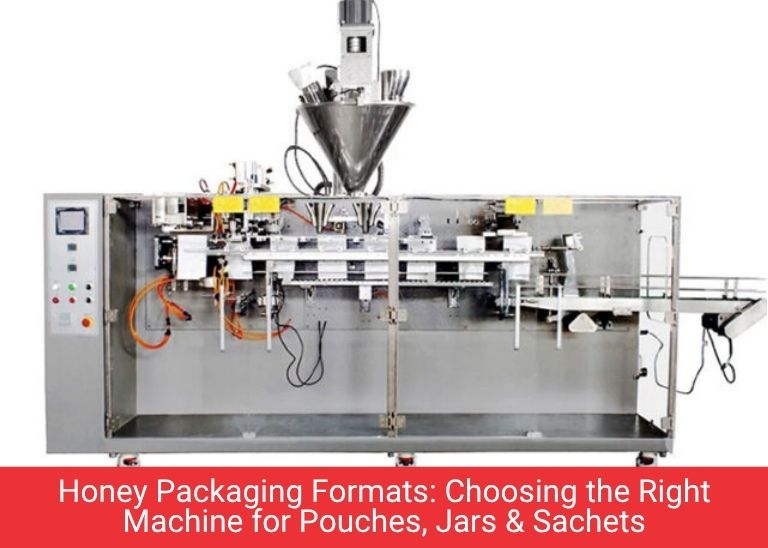
The liquid pouch packing machine for honey operates on the horizontal PFS (pick fill seal) or VFFS (vertical form fill seal) principle, forming pouches from a reel of flexible laminated film, filling each pouch with a precisely measured volume or weight of honey, and sealing the filled pouch. The paste pouch filling machine configuration for honey uses a positive displacement piston filler or a gear pump filler that is insensitive to honey’s high and variable viscosity, ensuring consistent fill volumes regardless of honey type or temperature.

Want to Discuss?
Call Call Us Now!

Key Machine Features for Pouch Honey Packing

A honey pouch packing machine must address the specific challenges of honey as a filling product. Heated product supply lines and a heated hopper maintain honey at a consistent temperature and therefore a consistent viscosity throughout the production run. Anti-drip nozzle assemblies with positive cut-off prevent honey stringing between fill cycles, which would contaminate the seal area and cause seal failures. Stainless steel product contact surfaces throughout the paste pouch filling machine are mandatory for food-grade hygiene compliance. Automatic pouch packing machine configurations with servo-driven pouch forming and filling allow recipe storage for rapid changeover between pouch sizes.

Honey in Jars and Bottles: The Premium Retail Format

The Commercial Case for Jar and Bottle Honey

Glass jars and PET or HDPE bottles are the packaging formats associated with premium, artisan, and branded honey products in both domestic and export markets. The jar format conveys quality, naturalness, and transparency that pouch packaging cannot match. Consumers can see the honey directly through the clear glass or PET container, and the colour, clarity, and texture of the honey become part of the product’s sensory appeal. Premium honey brands in the organised retail, gifting, and health food segments predominantly use glass jars.

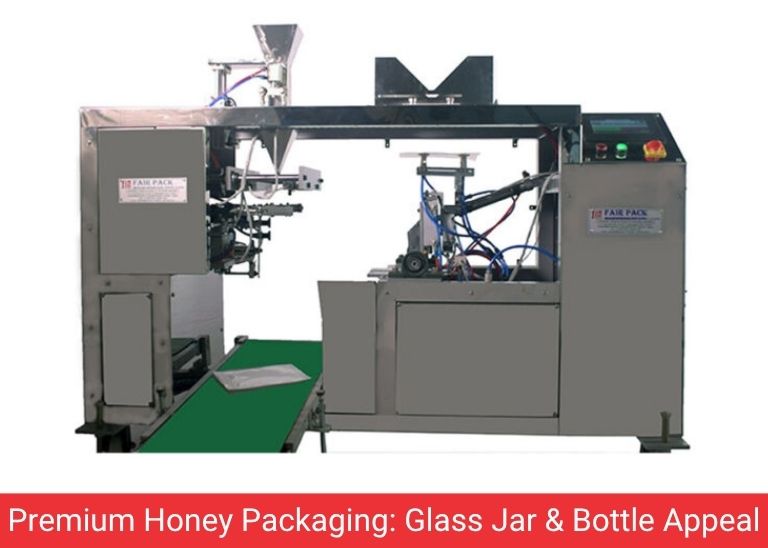
Bottle packing machines and jar filling machines for honey use rotary piston filling machines or linear piston filler configurations with heated product supply and anti-drip nozzle design. A rotary piston filling machine for honey can fill multiple jars or bottles per machine cycle, achieving production speeds of 20 to 80 containers per minute depending on the fill volume and container size. Automatic liquid packing machines for jar honey are available with inline capping, labelling, and date coding integration for complete automated line configurations.

Challenges Specific to Jar and Bottle Honey Packing

Honey filling into glass jars presents some specific challenges that are not present in pouch filling. Glass jars must be handled carefully to prevent breakage, requiring jar-specific conveyor designs with appropriate cushioning and speed control. The relatively wide mouth of a honey jar gives more room for the fill nozzle, but the viscosity of honey means that fill speed must be controlled to prevent air entrapment and the resulting foam on the honey surface that reduces visual appeal in a transparent container. Honey filled into clear glass jars must be free of air bubbles, which requires careful fill nozzle design and controlled fill speed.

Honey in Sachets: The Single-Serve and Institutional Format

The Commercial Case for Sachet Honey

Single-serve honey sachets are a large and growing segment of the honey market, driven by demand from the hotel and restaurant sector, airline catering, hospital nutrition services, consumer packs for portion-controlled consumption, and the export market for value-added single-serve formats. A 10-gram or 15-gram honey sachet in a multitrack packaging machine configuration can produce 400 to 800 sachets per minute across multiple tracks, making sachet honey packaging one of the highest-productivity applications for the multitrack FFS machine.

The sachet pouch packing machine for honey uses a liquid fill head or paste fill head that is integrated into a multitrack packaging machine platform. The fill head design for honey sachets must include anti-drip and positive cut-off features that prevent honey from depositing on the longitudinal seal area of the sachet film, which would cause seal failures at the high production speeds characteristic of multitrack machines.

Sachet Film Selection for Honey

Honey sachet film must provide adequate moisture barrier, adequate strength for the sachet format without being excessively stiff, and the heat-seal compatibility required by the multitrack packaging machine’s sealing system. Laminated films combining a printed outer layer with a barrier mid-layer and a heat-sealable polyethylene inner layer are the standard choice for honey sachets. For export-market sachets, film with higher barrier specification is typically required to maintain honey quality over longer shelf life periods.

Choosing the Right Honey Packing Machine: A Format Decision Framework

Format

Target Market

Key Machine

Production Speed

Stand-up pouch

Supermarket, online, modern trade

Paste pouch filling machine with anti-drip

20 to 80 pouches per minute

Flat pouch

Mass market, price-sensitive

Automatic pouch packing machine

30 to 100 pouches per minute

Glass jar

Premium retail, gifting, export

Rotary piston filling machine

20 to 60 jars per minute

PET or HDPE bottle

Organised retail, health food

Automatic liquid packing machine

30 to 80 bottles per minute

Single-serve sachet

Hotels, airlines, institutions

Multitrack FFS machine with liquid fill head

400 to 800 sachets per minute

Bulk jar or container

Foodservice, bakery, industrial

Semi-automatic piston filler

By batch volume

Fair Pack Machineries Honey Packing Solutions

Fair Pack Machineries offers a complete range of honey packing machine solutions covering all three primary formats. The company’s paste packaging machines and piston fillers handle honey pouch and jar filling applications with the viscosity management, anti-drip nozzle design, and food-grade hygiene features that honey filling requires. The company’s multitrack packaging machines accommodate honey sachet filling with high-speed liquid fill head configurations. Integration of complete honey packaging lines, including product conveying, filling, sealing, capping, coding, and finished goods handling, is available from Fair Pack as a single integrated solution.

Conclusion

The honey packing machine investment is most successful when it is grounded in a clear understanding of the target market, the required format, and the production scale. Each of the three primary honey packaging formats, pouches, jars and bottles, and sachets, has a distinct commercial logic and requires a distinct machine configuration. Fair Pack Machineries has the product range and application expertise to guide honey producers to the right machine choice for their specific market position and production requirements.

x

Call now

    agree that Steeler will collect my name and email information
    ×