
Fair Pack

Leading Packaging Machinery Manufacturer – Aseptic, VFFS, Multihead Weigher, Auger Filler, Flow Wrap, PFS & Semi-Automatic Machines | Serving India, UAE, Saudi Arabia, Africa, Europe, USA & More

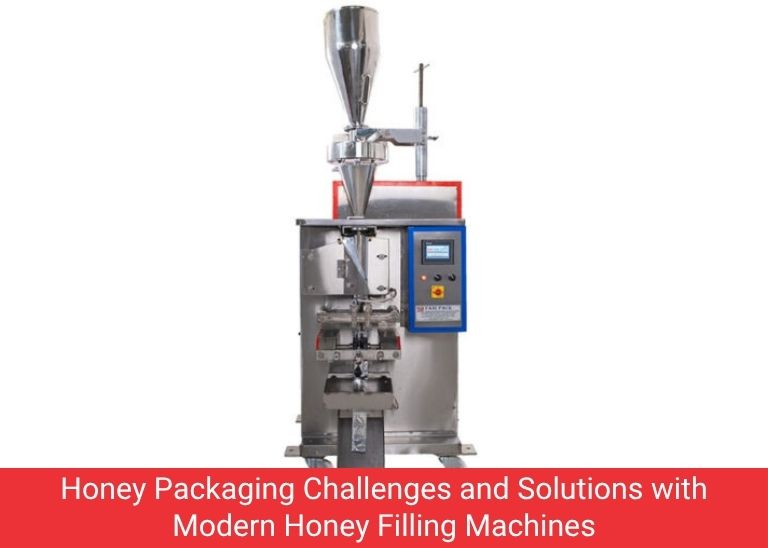
Challenges of Packing Honey and How Modern Honey Filling Machines Solve Them

Honey as a Packaging Challenge

Honey is one of the oldest and most universally consumed natural food products in the world, and India is one of its most significant producers and exporters. The Indian honey market has been growing steadily, supported by strong domestic demand and growing export volumes to the European Union, the United States, and other international markets. However, honey presents a uniquely challenging set of characteristics that make efficient, hygienic, and accurate packaging significantly more technically demanding than most other food products. Understanding these challenges, and the solutions that modern honey filling machines and honey packing machines provide, is essential for any honey producer, processor, or packer who wants to operate efficiently and competitively.

We’re Just a Call Away
Contact Now!

The Key Challenges of Honey Packaging

Challenge 1: High and Variable Viscosity

Honey’s viscosity varies significantly depending on its botanical source, water content, temperature, and crystallisation state. Raw honey at room temperature can have a viscosity of 2,000 to 10,000 centipoise or higher, making it extremely difficult to flow quickly and consistently through conventional filling systems designed for low-viscosity liquids. As honey cools, viscosity increases further, slowing fill rates and creating inconsistency in fill volumes between the start and end of a production run. Creamed honey and set honey have viscosities that are orders of magnitude higher than liquid honey, requiring entirely different filling approaches.

A modern honey filling machine addresses viscosity variation through heated product hoppers and fill lines that maintain honey at a controlled temperature where viscosity is consistent and predictable, through positive displacement piston filler mechanisms that are insensitive to viscosity variation within a defined range, and through servo-driven fill cycles that can be programmed to accommodate different honey viscosities through recipe storage.

Challenge 2: Stringiness and Dripping

One of the most practical challenges in honey packaging is the tendency of honey to string, that is, to form a thin thread of liquid that follows the fill nozzle upward as it retracts after depositing honey into the container. This stringing behaviour deposits honey on the outside of the container, on the fill nozzle, and on the sealing surfaces, creating hygiene problems, seal contamination, and a messy appearance on the finished product. In high-speed honey packing operations, this can result in significant product wastage and frequent cleaning shutdowns.

Modern honey filling machines incorporate anti-drip nozzle designs with positive cut-off mechanisms that draw the liquid back slightly at the end of each fill cycle, preventing stringing. Some models incorporate heated nozzle assemblies that reduce the viscosity of honey at the nozzle tip to create a cleaner cut-off. These design features are essential for efficient, hygienic honey packing at commercial production speeds.

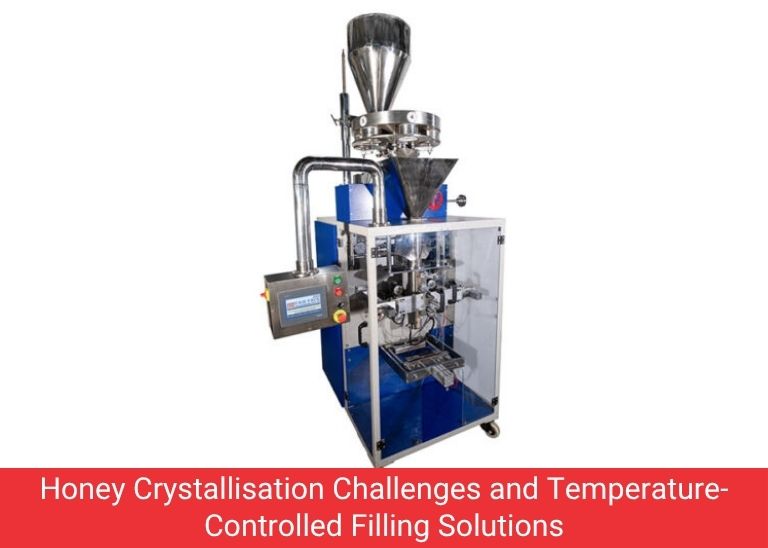
Challenge 3: Crystallisation

Honey is a supersaturated sugar solution that is thermodynamically inclined to crystallise over time. While crystallisation is a natural process that does not affect the quality or safety of honey, it creates significant challenges for packaging operations because crystallised honey cannot be filled through conventional liquid filling equipment. Producers who pack honey on an infrequent basis may find that honey in their storage or supply lines has partially crystallised between production runs, requiring heating and liquefaction before packing can resume.

A well-designed honey packing machine incorporates heated product holding systems, heat-traced supply lines, and temperature-controlled hoppers that maintain honey in a liquid state throughout the production run. This eliminates the crystallisation-related downtime that affects honey packers who use non-specialised filling equipment.

Challenge 4: Hygiene and Food Safety

Honey is a food product with strict hygiene requirements at the packaging stage. Contamination of honey with foreign materials, water from cleaning residues, or microorganisms from inadequately cleaned equipment is a serious food safety risk that can also damage the premium natural image that honey commands in the consumer market. Honey filling machines and honey packing machines used in commercial production must meet food-grade hygiene standards with all product-contact surfaces in food-grade stainless steel, tool-free disassembly for cleaning and sanitisation, and design features that eliminate dead zones where honey can accumulate and degrade between production runs.

Challenge 5: Fill Accuracy for Different Container Formats

Honey is packed in a wide variety of container formats including glass jars, PET bottles, HDPE squeeze bottles, pouches, sachets, and bulk containers. Each format has different filling requirements in terms of nozzle design, fill speed, container holding mechanism, and capping or sealing integration. A honey packing machine manufacturer who offers multiple filling configurations and can customise the machine for the producer’s specific container mix provides significantly more operational flexibility than one who offers a single standard configuration.

Types of Honey Filling Machines

Machine Type

Best Suited For

Key Features

Piston filler for honey

Jars, bottles, pouches

Positive displacement, anti-drip nozzle, heated

Rotary piston filling machine

High-speed jar and bottle filling

Multiple fill heads, servo-driven, precise

Peristaltic filler

Small batch, premium honey varieties

Gentle product handling, easy changeover

Auger-based paste filler

Creamed honey and set honey

Handles very high viscosity products

Automatic liquid packing machine

Sachet and pouch formats

Form fill seal with heated product supply

Modern Solutions: What a Quality Honey Filling Machine Provides

A modern automatic honey filling machine from a quality liquid packaging machine manufacturer addresses the full set of honey packaging challenges through an integrated design approach. Heated product holding with temperature control maintains honey viscosity at a consistent, fillable level throughout the production run. Positive displacement piston fill mechanisms deliver accurate, repeatable fill volumes regardless of viscosity variation within the design range. Anti-drip positive cut-off nozzles prevent stringing and contamination of sealing surfaces and container exteriors. All product-contact surfaces in food-grade stainless steel meet FSSAI and export market food safety standards. Servo-driven fill cycles with recipe storage allow rapid and accurate changeover between different honey varieties, container sizes, and fill weights. Integration with capping, labelling, and date coding systems enables a complete honey packing line from a single supplier.

Quick Response Guaranteed
Message us on WhatsApp Email Us Now!

Fair Pack Machineries and Honey Packing Solutions

Fair Pack Machineries offers a range of paste packaging machines, piston fillers, and liquid packaging machines that are suitable for honey packing applications. The company’s experience in designing filling systems for viscous and semi-viscous food products including pastes, sauces, and honey makes it a knowledgeable partner for honey producers who are scaling up their packing operations or upgrading from manual to automated filling. Fair Pack’s solutions for honey packing combine hygienic design, fill accuracy, and operational reliability to support Indian honey producers in meeting both domestic market requirements and the strict quality standards of export markets in Europe, the USA, and the Gulf.

Conclusion

Honey packing is more demanding than it appears, and the selection of the right honey filling machine is a decision that has direct implications for production efficiency, product quality, regulatory compliance, and export market access. Modern honey packing machines address the full range of challenges that honey presents as a packaging material, from viscosity management and anti-drip performance to hygienic design and fill accuracy. Fair Pack Machineries invites honey producers, processors, and co-packers to discuss their specific honey packing requirements and identify the filling solution that best fits their product range, container formats, and production volumes.

x

Call now

    agree that Steeler will collect my name and email information
    ×