Flow Wrap Machines: Why Servo Technology Matters
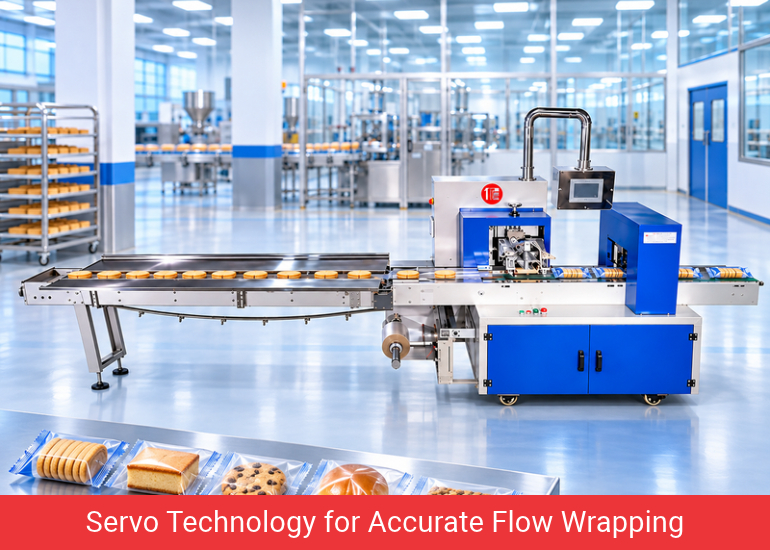
Flow Wrap Machines form, fill, and seal film around products in one continuous horizontal process.
Every pack depends on four movements staying in step: product travel, film feeding, sealing, and cutting.
As automatic packaging technology spreads across food, FMCG, and industrial plants, how these movements are driven matters more. Servo technology is one of the main ways engineers control them.
For technical buyers, motion control is a key selection criterion. Servo configuration is therefore an important factor when evaluating flow wrapping equipment from Fair Pack Machineries and other packaging machinery suppliers.
Automatic Packaging Technology: How Servo Control Works
A servo motor works in a closed loop. An encoder reports actual position and speed to a drive, which corrects any difference from the command.
The drive follows instructions from a PLC or motion controller. Machine programming defines how each servo axis moves relative to the others.
This links several movements electronically instead of through shafts, gears, and cams. The relationship between axes can then be changed in software.
Still, the servo motor is only one component. Sensors, mechanical design, programming, and tuning together decide how the machine performs.
That is why configurations vary. Some designs use servo drives on one or two key axes, while others drive most movements independently. Buyers should confirm the exact arrangement on any Fair Pack Machineries model they evaluate.
Servo Flow Wrap Machine Film Feeding and Product Movement
Film leaves the reel, passes over a forming box, and wraps into a tube around the product.
The film must advance exactly one pack length per cycle. With printed film, a registration sensor reads the print mark so graphics land in the same place on every pack.
Products arrive on an infeed conveyor, usually with lugs or pushers. Their pitch must match the film pitch so each product sits centrally between seals.
Uneven feeding causes visible faults. Products drift toward seals, pack lengths vary, or cuts fall through printed areas.
Film thickness, stiffness, and surface friction also affect how the tube tracks. Sharing film and product samples with Fair Pack Machineries early helps match settings to both.
Precision Packaging Machine: Servo Sealing and Cutting Control
The longitudinal seal is made continuously by fin wheels along the tube. End sealing and cutting happen intermittently, where cross-seal jaws meet the moving film.
Where the end-sealing unit is servo-driven, jaw motion can be profiled. Depending on the design, jaws can slow to match film speed during contact and move faster away from the pack.
This can help keep the cut aligned with film registration and allows contact time to be tuned for different pack lengths.
Seal quality depends on more than motion. Jaw temperature, pressure, dwell time, film sealant layer, and product contamination in the seal area all matter.
A precision packaging machine therefore still needs correct setup. Jaw alignment, blade condition, and heater performance must be maintained, and Fair Pack Machineries’ operating documentation should be followed for each model.
Servo Flow Wrap Machine Applications for Different Products
A servo flow wrap machine is used for biscuits, wafers, bread, confectionery, soap bars, medical disposables, and hardware components.
Each product brings different handling demands. Fragile items need gentle acceleration, while long or irregular items may need variable pack lengths.
Grouped products, such as stacked biscuits, need stable collation before wrapping. Soft products may need controlled speed to avoid deformation.
These factors decide how many servo axes are useful and where. A uniform product rarely needs the same configuration as a mixed-format line.
Fair Pack Machineries lists packing machines for wafers, bread, sweets, and noodles alongside its automatic flow wrap packing machine. Product trials remain the surest way to confirm suitability.
Flow Wrap Packing Machine Repeatability and Packaging Consistency
Repeatability describes how consistently the machine produces the same result, while accuracy describes how closely that result matches the intended pack dimensions and registration.
A flow wrap packing machine can be highly repeatable yet consistently slightly off target, so both must be checked during setup.
On servo-driven axes, electronic motion control can improve repeatability by coordinating programmed movements, provided the machine is correctly configured, tuned, and maintained.
Consistency can still drift. Reel changes, temperature variation, product dimension spread, and conveyor wear all shift outcomes.
Performance should be validated with the actual product, film, and target speed. Ask Fair Pack Machineries whether acceptance trials can be arranged before dispatch.
Flow Wrap Machine Changeover Flexibility for Different Products
Changeovers bring new product dimensions, pack lengths, or film specifications. On mechanically driven machines, this can mean changing gears or cams.
Where supported, servo control stores settings as recipes. The operator selects a product, and the controller loads its motion parameters.
Physical adjustments usually remain. Forming boxes, guides, fin wheel positions, and film reels may still need changing.
After each changeover, the first packs should be checked for registration, seal integrity, and length. Operator training decides how quickly this is done.
Ask Fair Pack Machineries which changeover features the quoted model offers, and request a demonstration on your own product range where possible. Changeover time often matters as much as running speed.
Horizontal Flow Wrap Packaging Machine Integration with Automated Lines
A horizontal flow wrap packaging machine rarely works alone.
Upstream, it may receive products from ovens, cooling conveyors, distribution systems, or manual loading stations.
Downstream, packs may move to checkweighers, metal detectors, labelling units, or cartoners. Each machine must handle product at a compatible rate.
Line synchronization can use speed signals, product sensors, or network communication between controllers. Buffer conveyors absorb short stops.
Signal types, communication protocols, and start-stop logic must match across suppliers. Sharing your line layout with Fair Pack Machineries at the planning stage helps avoid interface mismatches.
Our Other Products
Flow Wrap Packaging Machine Buying Checklist: Key Factors to Evaluate
A flow wrap packaging machine should be selected against documented requirements. Use these questions with Fair Pack Machineries or any supplier:
- What product dimensions, weights, and tolerances can the machine handle?
- Which film structures and thicknesses have been tested on it?
- What output is realistic for my product, not just the rated maximum?
- Which axes are servo-driven, and which are mechanical?
- Can recipes be stored, and which adjustments stay manual?
- What footprint, utilities, and line interfaces are required?
- How accessible are jaws, blades, and wear parts for maintenance?
- Which manuals, electrical drawings, and spare-parts lists are supplied?
- What operator and maintenance training is included?
Confirm answers in writing and verify them during trials. Weigh film, power, spares, and staffing needs alongside purchase price.
Flow Wrap Machine Manufacturer Selection: How to Choose the Right Partner
A capable flow wrap machine manufacturer should show experience with products similar to yours, through sample packs or reference applications.
When comparing flow wrap machine manufacturers, request the drive layout, controller type, and software features for the exact model quoted.
A dependable flow wrap packaging machine manufacturer should run trials with your product and film. A live demonstration reveals more than a specification sheet.
Installation, commissioning, training, and maintenance documentation matter too. A flow wrap packing machine supplier should explain how support is provided after delivery.
Fair Pack Machineries manufactures and supplies automatic packaging equipment, including flow wrap packing machines, for customers in India and overseas. Confirm machine configuration, control features, and application suitability with Fair Pack Machineries before finalizing your purchase.