Fair Pack

Leading Packaging Machinery Manufacturer – Aseptic, VFFS, Multihead Weigher, Auger Filler, Flow Wrap, PFS & Semi-Automatic Machines | Serving India, UAE, Saudi Arabia, Africa, Europe, USA & More

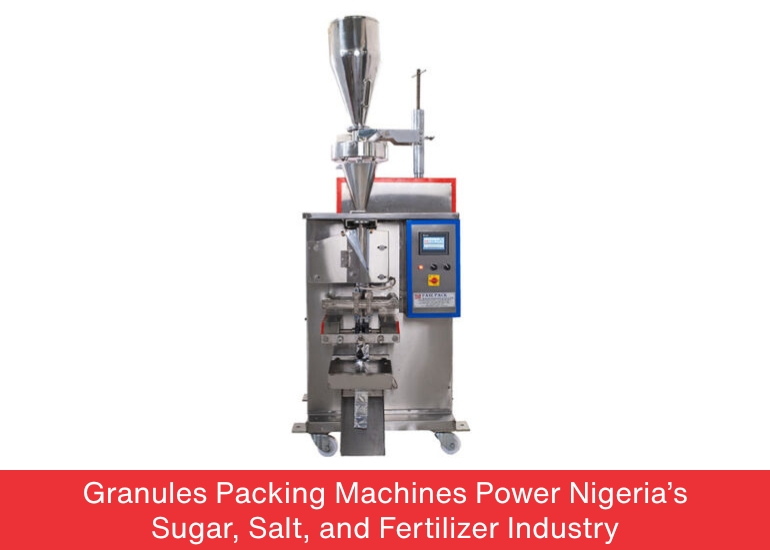
Granules Packing Machines for Nigeria's Sugar, Salt and Fertiliser Packaging Industry

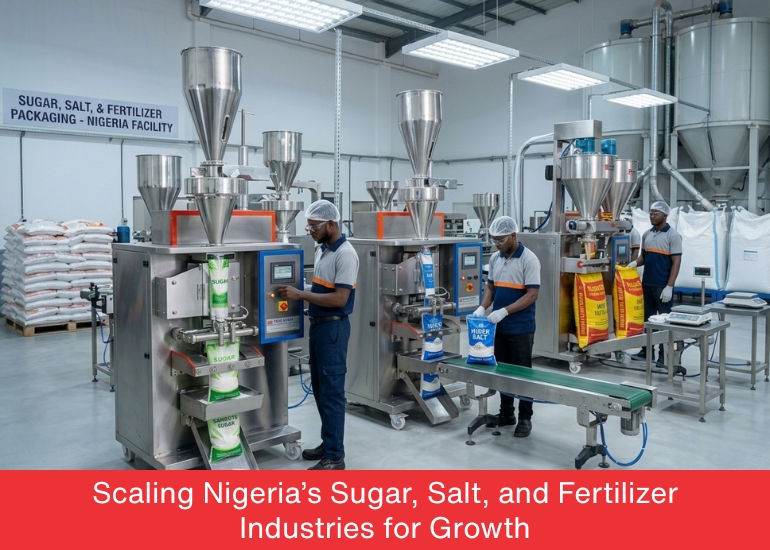
Nigeria is Africa’s largest economy and most populous nation, with over 220 million people and a fast-developing industrial base. The country’s food processing, agricultural input, and commodity distribution sectors represent some of the continent’s most significant packaging markets. Among the most important product categories requiring large-scale granule packaging are sugar, salt, and fertilisers — three commodities that are consumed or applied in enormous quantities across Nigeria’s urban and rural populations. For manufacturers, processors, and distributors in these sectors, the granules packing machine Nigeria is increasingly a critical piece of infrastructure — enabling faster, more accurate, more hygienic, and more brand-consistent packaging than manual or semi-manual methods.

Boost your production with Efficient Packing, Filling & Conveyors
Call Call Now!

Nigeria's Sugar, Salt, and Fertiliser Markets: Scale and Opportunity

Sugar. Nigeria is both a producer and a major importer of refined sugar. Domestic refineries process raw cane sugar and import sugar for repackaging. The retail sugar market is dominated by 500g, 1kg, and 2kg packs sold through open markets, convenience stores, and supermarkets in Lagos, Abuja, Kano, Port Harcourt, and other major cities. Industrial sugar supply to food manufacturers — bakeries, beverage producers, confectionery factories — requires accurate, hygienic bulk and retail packaging.

Salt. Nigeria’s salt market — supplied primarily from local brine extraction in Cross River State and imported sources — is enormous. Salt is consumed at the household level in 200g to 1kg packs and supplied to food manufacturers in 25kg and 50kg bags. The retail packaged salt market has grown significantly as consumers shift from loose bulk salt to branded, hygienically packaged retail formats.

Fertiliser. Nigeria’s agricultural sector — producing cassava, maize, sorghum, rice, yam, and a range of other crops — depends heavily on fertiliser application for yield improvement. The Federal Government’s fertiliser subsidy programmes, particularly the Presidential Fertilizer Initiative (PFI), have significantly increased fertiliser distribution volumes. Granular fertilisers — NPK compound fertilisers, urea, and speciality fertiliser blends — are packed in 25kg and 50kg bags, as well as smaller 1kg and 5kg retail formats for smallholder farmers.

In all three sectors, the shift from manual scooping and manual bag filling to mechanised granule packing has been accelerating — driven by the need for better weight accuracy, faster throughput, improved hygiene, and more consistent product presentation.

What Is a Granules Packing Machine?

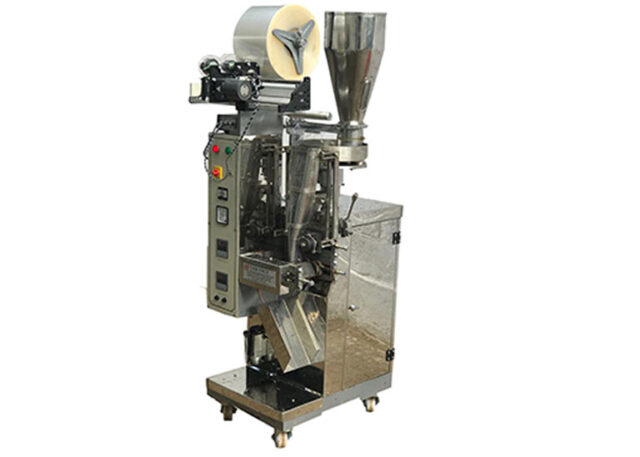
A granules packing machine is a filling and sealing system designed to pack free-flowing or semi-free-flowing granular products into bags, pouches, or other containers at controlled, consistent fill weights. The machine dispenses product through a filling system — volumetric cup, screw conveyor, or combination weigher — into the container, then seals the opening with a heat sealer, tie, or stitcher depending on the container type and product.

Granule packing machines are available in several configurations, each suited to different products, volumes, and pack sizes:

FFS Volumetric Granule Packing Machine. The most commonly used configuration for free-flowing granules (sugar, salt, pulses) in pouch formats of 100g to 5kg. A vertical form fill seal (VFFS) machine forms a pillow pouch from a reel of laminated film, the volumetric cup system dispenses a calibrated volume of product, and the machine seals and cuts each pack. Speeds typically range from 20 to 80 packs per minute depending on pack size and product characteristics.

Weighmetric Granule Packing Machine. Uses a load cell-based weighing system rather than a volumetric cup — measuring the weight of each fill directly, rather than estimating it from volume. This provides higher accuracy, particularly for products with variable density, and is preferred for high-value products where giveaway is costly.

Multihead Weigher Granule Packing Machine. For premium granular products — specialty salts, fortified sugar, premium fertiliser blends — where very high accuracy and speed are required, a multihead combination weigher integrated with a VFFS machine delivers the best performance.

Open Mouth Bag Filler. For large-format packaging — 25kg and 50kg fertiliser bags — an open mouth bag filling and sewing machine dispenses product from a hopper (gravity or auger-fed) into pre-formed woven PP bags, which are then stitched or heat-sealed closed. These machines handle very high throughput (20–60 bags per minute) essential for bulk fertiliser distribution.

Multitrack Granule Packing Machine. For small-format sachets of salt, sugar, or fertiliser (5g to 100g) for institutional, catering, or single-use applications, multitrack machines running four to twelve lanes simultaneously produce sachets at rates of hundreds per minute.

Sugar Packaging: The Retail and Industrial Dimensions

For sugar processors and importers in Lagos, Kano, and Apapa, the granules packing machine Nigeria context has two distinct dimensions:

Retail packaging (500g, 1kg, 2kg pouches) requires VFFS machines with volumetric or weighmetric filling for accurate, attractive, branded pouches. The sugar packing machine must handle refined sugar — a free-flowing, hygroscopic granule that clumps in high humidity — with appropriate hopper agitation, temperature-controlled forming, and robust seal performance. Moisture barrier laminated film (OPP/PE or metPET/PE) is essential to prevent caking in Nigeria’s humid climate.

Industrial supply (25kg and 50kg bags) uses open mouth bag fillers for supply to bakeries, beverage companies, and food manufacturers. Accuracy in large-format bags (±50–100g on a 25kg fill) is achievable with load cell-based weighing systems.

Salt Packaging: From Lagos Retail to Northern Nigeria Distribution

Salt packaging in Nigeria presents specific challenges. Salt is hygroscopic, abrasive, and corrosive — requiring granule packing machines built with stainless steel or corrosion-resistant product-contact parts (SS 316L strongly recommended). Salt can also be very fine (vacuum-evaporated salt) or quite coarse (solar salt) — requiring appropriate feeding and metering systems for each grade.

For the granule filler Africa market, salt packing machines must also cope with Nigeria’s climatic conditions: high ambient temperature, high humidity, and potential power fluctuations. Machines with robust sealing systems — including servo-driven jaw drives that maintain sealing force regardless of speed — produce better seal quality and fewer rejects than simpler mechanical cam-driven machines.

Key Salt Packaging formats in Nigeria:

  • 200g and 500g sachets for household use — VFFS with volumetric cup
  • 1kg pouches for retail — VFFS with weighmetric filling
  • 25kg woven bags for institutional and industrial supply — open mouth bag filler

Fertiliser Packaging: The NPK and Urea Dimension

Nigeria’s fertiliser packaging sector is large and strategically important. The Presidential Fertilizer Initiative has significantly expanded fertiliser distribution, and packaging quality — ensuring correct weight, proper bag sealing, and accurate labelling — is critical for farmer trust and government programme accountability.

Granular NPK fertilisers (e.g., 15-15-15, 20-10-10) are free-flowing and well-suited to volumetric or weighmetric filling on open mouth bag filling machines. Key requirements for sugar salt fertiliser packaging Lagos and nationwide include:

  • Corrosion resistance — fertiliser salts are chemically aggressive; all product-contact parts must be SS 316L or HDPE/polypropylene for appropriate resistance
  • Dust containment — fertiliser dust is an irritant and can create housekeeping and safety issues; filling machines should include local exhaust ventilation (LEV) or enclosed filling spouts
  • High throughput — during planting season, fertiliser distribution is time-critical; packing lines must achieve 20–50 bags per minute for 25–50kg bags
  • Bag type compatibility — woven polypropylene bags, laminated bags, and kraft paper bags must all be handled
  • Accurate fill weight — under the government subsidy programme, short-weight bags are a serious compliance risk; weighmetric filling with checkweighing is strongly recommended

Why Nigerian Manufacturers Are Investing in Granule Packing Machines Now

Several factors are converging to accelerate investment in mechanised granule packing in Nigeria:

Formalisation of retail. The growth of supermarkets, pharmacies, and modern trade in Nigerian cities is driving demand for consistently packaged, clearly labelled, accurately weighed products — requirements that manual packaging cannot reliably meet.

Regulatory compliance. Nigeria’s Standards Organisation (SON) enforces net weight regulations for packaged consumer goods. Non-compliant products face market withdrawal and fines.

Labour cost and reliability. While Nigerian manufacturing labour costs are lower than in developed markets, managing large manual packing teams — common at commodity packing operations — involves significant supervisory overhead, quality inconsistency, and shrinkage risk.

Export ambitions. Nigerian food manufacturers and commodity exporters targeting West African regional markets (Ghana, Benin, Ivory Coast) or international export require packaging quality and consistency that mechanised granule packing machines deliver.

Government industrial incentives. The Central Bank of Nigeria’s manufacturing sector support programmes and the Nigeria Export Promotion Council’s support for value-added agricultural exports provide financial support for capital equipment investment.

Quick Response Guaranteed
Message us on WhatsApp Email Us Now!

Conclusion

For Nigeria’s sugar processors, salt packers, and fertiliser distributors, the granules packing machine is not simply a productivity tool — it is a strategic enabler of formalisation, compliance, brand building, and market expansion. Whether filling 200g retail sachets of iodised salt for Lagos supermarkets, packing 1kg branded sugar pouches for distribution across the North, or filling 50kg NPK fertiliser bags for smallholder farmers in Benue and Kaduna States, the right granule packing machine delivers the speed, accuracy, hygiene, and consistency that Nigeria’s fast-growing and demanding packaging market requires.

As Nigerian manufacturing continues to modernise and as both domestic retail standards and export market requirements rise, investment in quality granule packing equipment is one of the most practical and high-return decisions a food or agro-processing manufacturer can make.

x

Call now

    agree that Steeler will collect my name and email information
    ×