

Fair Pack

Leading Packaging Machinery Manufacturer – Aseptic, VFFS, Multihead Weigher, Auger Filler, Flow Wrap, PFS & Semi-Automatic Machines | Serving India, UAE, Saudi Arabia, Africa, Europe, USA & More

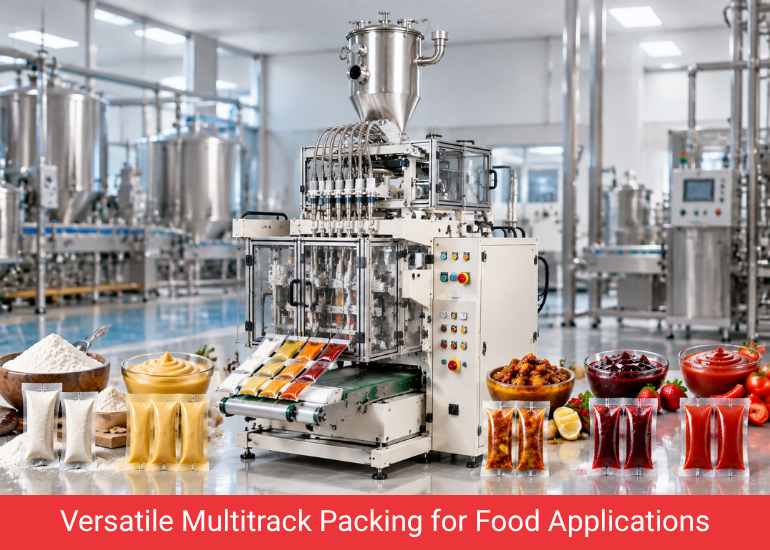
A Multitrack Packing Machine fills and seals multiple pouches at once, but the product being packed determines how it must be configured. Masala powders, pharmaceutical powders, pickles, jams, and sauces behave differently on a filling line. Powders flow and settle, pastes resist flow and cling to surfaces, and liquids drip if not controlled.

For buyers evaluating a Masala Packing Machine, a Pickles packing machine, a Masala powders Packing Machine, a Pharmaceutical powders Packing Machine, a Jams Packing Machine, or a Sauce Packing Machine, the real question is not which machine to buy, but how a multitrack platform should be configured for that product. Filling head type, track count, pouch format, and contact parts change based on consistency, viscosity, flowability, particle size, and solid content.

Why Product Characteristics Matter in Multitrack Packaging

No single filling setting works for every product. A machine tuned for free flowing powder will underfill or overfill a thick paste, and a setting built for paste will not suit a thin sauce. Consistency and viscosity determine how material moves through a hopper, feed screw, or nozzle, and a dry masala powder flows differently from a finer pharmaceutical powder, a viscous jam, or a chunky pickle. Powders rely on volumetric or gravimetric feeding, pastes need positive displacement, and semi liquids need controlled flow to avoid splashing. The right technology matches filler type and feed system to the product.

We are Fast in Response
Contact Now!

Multitrack Packing Machine for Masala and Masala Powders

A Masala Packing Machine built on multitrack technology suits producers needing consistent, high volume sachet output for spice blends. Masala powders Packing Machine configurations typically use auger filling, where a rotating screw meters powder by volume into each pouch, suiting free flowing to moderately dense powders with fine control over fill quantity.

Dust control matters with fine masala powders, since airborne particles affect hygiene and seal quality, and enclosed hoppers with controlled discharge points limit dust generation. Auger dosing also lets multiple small sachets be filled and sealed simultaneously without sacrificing accuracy for low gram retail packs.

Machine design affects how easily a line adapts to different blends, since coarser and finer powders behave differently under the same auger setting. Switching between products typically means resetting auger parameters and, where needed, swapping contact parts. Sealing consistency across all tracks matters too, since uneven pressure on one track can weaken seals elsewhere.

Packing Pharmaceutical Powders with Multitrack Technology

A Pharmaceutical powders Packing Machine configuration prioritizes dosing precision and contamination control over raw speed alone. Pharmaceutical powder applications generally require controlled dosing accuracy, hygiene focused design, and suitable material compatibility depending on the formulation, since powders vary in particle size, density, and moisture sensitivity.

Enclosed product paths, minimal manual handling, and cleanable surfaces reduce contamination risk, and stainless steel contact parts are commonly specified since they resist corrosion and do not react with sensitive formulations. Machine design also has to account for changeover, since different formulations on the same line may need contact parts removed, cleaned, and refitted between batches. Filling accuracy depends on each auger head being calibrated independently, and sealing consistency is checked alongside dosing accuracy.

Pharmaceutical packaging requirements vary between products and regulatory contexts. Fair Pack Machineries does not claim that every configuration meets a pharmaceutical standard, and buyers should confirm requirements before finalizing a specification.

Handling Pickles with the Right Multitrack Filling System

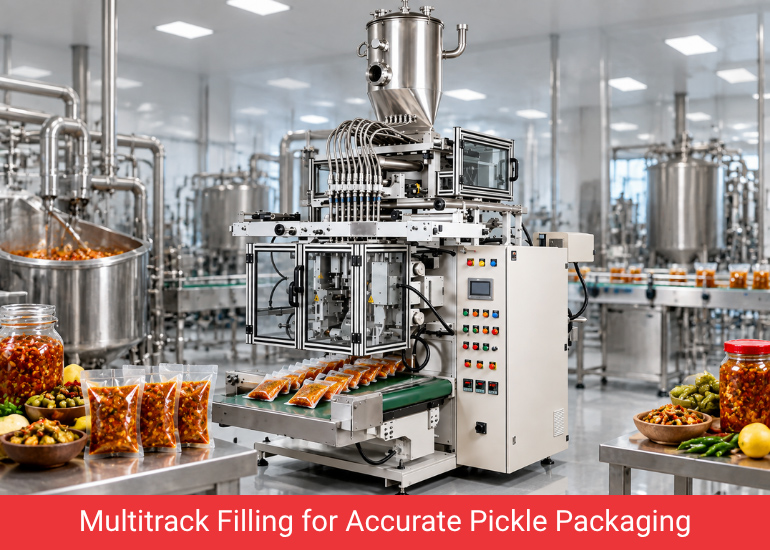
A Pickles packing machine must handle products that are rarely uniform, since pickles often combine liquid brine with solid pieces of varying size. Paste and semi solid filling typically uses piston filling, where a piston draws product into a cylinder and discharges a set volume, handling thicker products more reliably than gravity systems.

Chunky versus smooth pickle products need different nozzle designs and clearances. Larger pieces need wider openings to avoid blockages, while smoother pastes allow tighter tolerances for precise dosing. Anti drip filling reduces residue around the pouch mouth, since residue on the seal area can weaken it, and cleanable contact parts help prevent buildup affecting fill accuracy over long runs.

Application suitability depends on how much solid content a product carries, since a line set for a mostly liquid pickle may need nozzle and piston changes to handle a chunkier variant. Switching between pickle types generally means adjusting piston stroke and, where solid size differs, changing the nozzle.

Multitrack Packing for Jams and Other Viscous Products

A Jams Packing Machine configuration is built around handling thick, sticky products that resist standard gravity flow. Heated filling is sometimes used, since gentle warming can reduce viscosity and improve flow, though this is not standard and should be specified based on product behavior at ambient temperature.

Viscosity affects nozzle sizing, piston speed, and cycle timing, since higher fruit solid content may need slower dosing than a thinner spread. Sealing consistency is particularly sensitive for jams, since residue trapped in the seal area can create a weak point even when fill weight is accurate, which is why nozzle behavior and seal jaw cleanliness are checked together.

Multitrack Sauce Packing: Choosing the Correct Filling Method

A Sauce Packing Machine needs a filling approach suited to the sauce, since sauces range from thin, pourable liquids to thicker semi liquid pastes. Piston filling suits thicker sauces, while linear filling suits thinner liquids, depending on flow and required dosing precision. Anti drip filling matters for sauces, since thin liquids are prone to dripping between cycles and can contaminate the sealing area, and portion control ensures each sachet receives a consistent quantity.

Application suitability comes down to whether a sauce is closer to a pourable liquid or a thicker consistency, since this affects which head and nozzle configuration holds portion accuracy. Moving between sauce types typically means adjusting piston stroke or valve timing rather than a full rebuild.

How Filling Heads Change According to the Product

Filling head selection is one of the most important decisions in configuring a multitrack system. A servo based auger filler suits powders such as masala blends and pharmaceutical powders. A piston filler suits pastes such as pickles and jams, using mechanical displacement for consistent volume per stroke. A linear filler suits liquids and thinner semi liquids such as sauces, using timed valve opening. One configuration cannot suit every product because the physical behavior of powders, pastes, and liquids differs too much for one mechanism.

Choosing the Number of Tracks for Different Applications

Track count is often discussed in ranges such as 3, 5, 8, 10, 12, and 16, with the appropriate number depending on production requirements rather than a fixed standard.

As a general pattern, lower counts such as 3 to 5 suit smaller producers or larger sachet sizes. Mid range counts such as 8 to 12 are typically associated with higher volume FMCG sachet production, where smaller pack sizes allow tighter spacing. Higher counts such as 16 are generally considered for maximum output applications where sachet size allows it. These are general patterns, and actual suitability depends on the specific product and pouch size.

Higher track counts increase throughput but also cost and complexity, so buyers should select a count aligned with production targets. However, track selection also depends on sachet width, dosing volume, and filling mechanism, since a thick paste cannot always use the same track density as a free flowing powder. Not every configuration is necessarily available for every application, and buyers should confirm current availability with Fair Pack Machineries directly.

Email Us for a Quick Response
Message us on WhatsApp Email Us!

From Masala Sachets to Sauce Sachets: Packaging Format Considerations

Stick pouches suit small, single dose quantities such as masala powder portions. Pillow pouches are a common general purpose format for powders, pastes, and semi liquids, suited to retail shelf display. Four side sealed pouches provide a flat, stable format used for premium presentation or when a wider seal area improves leak resistance. Single serve packs support food service and on the go consumption, and retail versus food service use often calls for different pouch strength.

How to Select a Multitrack Packing Machine for Your Product

Machine selection should start with product analysis, not equipment specs.

  • Product type determines whether auger, piston, or linear filling is the right starting point.
  • Fill weight or volume affects dosing system sizing and precision.
  • Viscosity influences nozzle design and whether anti drip or heated filling is needed.
  • Required PPM affects track count and filling head speed.
  • Number of tracks should be based on production volume and sachet size.
  • Hygiene requirements determine whether stainless steel contact parts are necessary.
  • Changeover frequency affects how quickly a line needs to adapt between products.

Fair Pack Machineries works with manufacturers, exporters, and suppliers across food, FMCG, and pharmaceutical sectors to assess these factors and configure a multitrack packing machine, along with supporting filling systems and conveyor systems.

Conclusion

A properly configured Multitrack Packing Machine can handle masala powders, pharmaceutical powders, pickles, jams, and sauces effectively, provided the filling technology and setup match the product. Auger filling suits powders, piston filling suits pastes, and linear filling suits thinner liquids.

Product type, flowability, viscosity, solid content, fill quantity, required PPM, filling head selection, number of tracks, pouch format, and hygiene requirements all influence which configuration is appropriate. Manufacturers should evaluate their product characteristics and production goals before selecting the filling technology, track configuration, and pouch format.

Fair Pack Machineries, as a manufacturer, exporter, and supplier of multitrack packing machines, filling systems, pouch packing machines, and conveyor systems, supports manufacturers in identifying the right configuration for their product.

x

Call now

    agree that Steeler will collect my name and email information
    ×