
Fair Pack

Leading Packaging Machinery Manufacturer – Aseptic, VFFS, Multihead Weigher, Auger Filler, Flow Wrap, PFS & Semi-Automatic Machines | Serving India, UAE, Saudi Arabia, Africa, Europe, USA & More

Horizontal Flow Wrap vs Vertical VFFS Packing Machine: Which Is Right for Your Product?

Two Dominant Packaging Technologies

In the world of flexible pouch and film packaging, two technologies account for the overwhelming majority of commercial production lines: the horizontal flow wrap machine and the vertical form fill seal (VFFS) packing machine. Both technologies form a pouch from a reel of flexible packaging film, fill that pouch with product, and seal it to produce a finished, retail-ready pack. Both are used in enormous volumes across food, pharmaceutical, and FMCG industries worldwide. Both are manufactured and exported by Fair Pack Machineries from Chennai, India.

Yet despite these similarities, horizontal flow wrap machines and vertical VFFS packing machines are not interchangeable. They are suited to fundamentally different product categories, different pack formats, different production environments, and different operational requirements. Making the right choice between them is one of the most important decisions a packaging line investor can make, and making the wrong choice results in machines that either cannot handle the product, produce unacceptable pack quality, or deliver inadequate production efficiency.

This article provides a clear, practical comparison of horizontal flow wrap packaging machines and vertical VFFS packing machines across all the dimensions that matter for packaging decision-makers: how each works, which products each suits best, pack format and appearance considerations, film compatibility, speed and output, hygiene and cleaning requirements, and total cost of ownership.

How Each Technology Works

How the Horizontal Flow Wrap Machine Works

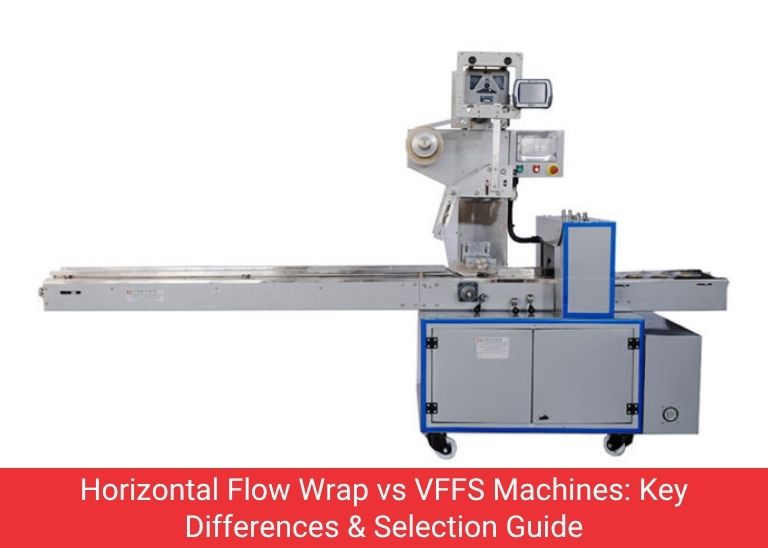
A horizontal flow wrap packaging machine, also called a flow wrapper or horizontal form fill seal machine, operates with the product and the film moving horizontally through the machine. Products are fed onto an infeed conveyor and travel horizontally into a film forming tube that wraps film around the product from above and below. A longitudinal fin seal or lap seal is formed along the bottom of the product as it travels through the machine. Transverse sealing jaws then close ahead of and behind each product, creating the end seals that complete the package and separate it from the next pack in the continuous production flow. The finished pack, typically a pillow-shaped package, exits on an outfeed conveyor.

The fundamental characteristic of flow wrap technology is that the product travels horizontally through the machine and is surrounded by film rather than dropped into a film tube from above. This makes flow wrap technology the natural choice for solid, rigid, and semi-rigid products that have a defined shape and that can be conveyed horizontally without deformation.

How the Vertical VFFS Packing Machine Works

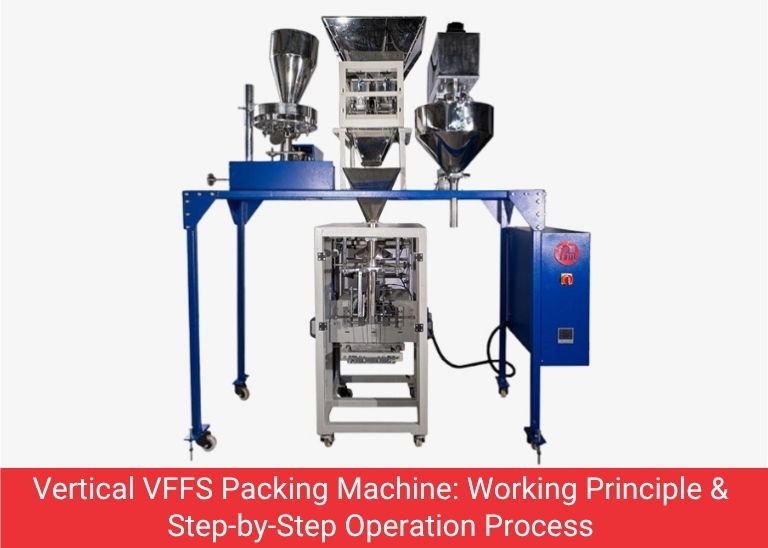
A vertical form fill seal packing machine, commonly called a VFFS machine or collar type packing machine in the Indian market, forms a film tube vertically around a central forming collar. Film is drawn from a reel, formed into a tube around the collar, and sealed along its length by a vertical sealing bar. Product is dispensed from above into the open top of the film tube through the collar. Transverse sealing jaws close below the product fill, creating the bottom seal of the next pack and the top seal of the current pack simultaneously, before cutting the finished pack free. The product falls into the pouch under gravity.

The fundamental characteristic of VFFS technology is that product enters the pack by falling vertically under gravity. This makes VFFS packing machines the natural choice for free-flowing products including granules, powders, liquids, and small solid pieces that can be dispensed from above. Collar type VFFS packing machines and multihead VFFS packing machines are the standard solutions for snack foods, spice powders, granules, and similar products in the Indian market.

Product Suitability: The Decisive Factor

Product Type

Flow Wrap Machine

VFFS Packing Machine

Biscuits and cookies

Ideal: rigid, flat, fed individually

Not suitable: shape lost in vertical drop

Chocolate bars

Ideal: rigid shape, precise wrapping

Not suitable

Bread, chapati, parotta

Ideal: flexible but defined shape

Not suitable

Soap bars

Ideal: rigid product, high-quality wrap

Not suitable

Candles

Ideal: rigid cylinder or pillar shape

Not suitable

Ready-to-eat meals in trays

Ideal: horizontal tray feeding

Not suitable

Chips and snack crisps

Not suitable: product fractures on infeed

Ideal with multihead weigher

Kurkure and puffed snacks

Not suitable

Ideal with multihead weigher

Namkeen and mixture

Not suitable

Ideal with multihead weigher

Masala and spice powder

Not suitable

Ideal with auger filler

Sugar and rice

Not suitable

Ideal with weigher or volumetric filler

Liquids and pastes

Not suitable

Ideal with appropriate liquid filler

Protein powder

Not suitable

Ideal with servo auger filler

Pack Format and Appearance

The horizontal flow wrap packaging machine produces a pillow pack format with a longitudinal seal along one face of the pack and transverse seals at each end. The pillow pack format provides a large printable surface area on both faces of the pack, and clear or clear-window film variants allow the product to be seen directly through the packaging. This is a commercially important advantage for bakery, confectionery, and personal care products where the product’s visual appearance is a key purchase driver. The pack format produced by a flow wrapping machine is widely recognised and trusted by consumers in these categories.

The vertical VFFS packing machine produces a pouch format with a back seal and bottom and top transverse seals, or in the pillow pouch variant, seals only at top and bottom. Gusset pouch, stand-up pouch, zipper pouch, and various other format options are available with appropriate forming collar designs. The VFFS pouch format is the dominant consumer packaging format for snacks, powders, and granule products in India and is immediately recognisable to consumers in these categories.

We are Fast in Response
Contact Now!

Speed and Production Output Comparison

Machine Type

Typical Speed

Best Production Scenario

Flow wrap machine

50 to 800 packs per minute

Single product, continuous feed, high volume

High speed flow wrapping machine

300 to 800+ ppm

Industrial biscuit and chocolate production

Collar type VFFS machine

30 to 120 ppm

Snacks, powders, granules in single track

Multihead VFFS packing machine

60 to 200 ppm

Snacks with multihead weigher integration

Multitrack FFS machine

200 to 1200+ sachets per minute

Small sachets, masala, pharmaceutical powders

Film and Packaging Material Compatibility

Both flow wrap packaging machines and VFFS packing machines can work with a wide range of flexible packaging films including plain polyethylene, polypropylene, laminated films with barrier layers, metallised films, and printed films. The key difference is in how the film is sealed. Flow wrap machines form seals on a film that is moving horizontally, and the sealing jaw geometry is different from the vertical sealing system of a VFFS machine. Film specifications are therefore slightly different for the two machine types, and a film roll specified for a flow wrapper may not perform optimally on a VFFS machine and vice versa. When switching between machine types, the film specification should be reviewed with the film supplier.

Hygiene and Cleaning

For food applications, both horizontal flow wrap machines and vertical VFFS packing machines can be supplied in food-grade stainless steel configurations. The flow wrapping machine configuration typically has a relatively open structure with good access to the sealing zone and product contact surfaces. The VFFS packing machine has a more compact structure around the forming collar and vertical fill tube, which requires attention to cleaning procedure design for products that produce dust or fine particles. For both machine types, regular preventive maintenance and cleaning schedules are essential for sustained production performance and food safety compliance.

Which Technology Does Fair Pack Machineries Recommend?

Fair Pack Machineries manufactures both horizontal flow wrap packaging machines and vertical VFFS packing machines in a wide range of configurations. The recommendation is always product-led: if your product is solid, has a defined shape, and is conveyed rather than poured, a flow wrap machine is almost certainly the right choice. If your product is a powder, granule, liquid, or small-piece solid that is dispensed from above by weight or volume, a VFFS packing machine is the right choice. For many food manufacturers who produce both types of products, both technologies are present in the factory, each serving the product categories it is best suited for.

Fair Pack invites producers to share product samples, production speed requirements, and pack format specifications so that the company’s technical team can recommend the most appropriate machine configuration for each specific application.

Conclusion

The choice between a horizontal flow wrap machine and a vertical VFFS packing machine is not a question of which technology is better overall. It is a question of which technology is right for your specific product. Understanding the fundamental differences in how each machine handles product, forms packs, and operates in production will ensure that your packaging machine investment delivers the performance, quality, and efficiency your business requires. Fair Pack Machineries is ready to support that decision with two decades of packaging machine manufacturing experience and a comprehensive range of both flow wrap and VFFS solutions.

x

Call now

    agree that Steeler will collect my name and email information
    ×