
Fair Pack

Leading Packaging Machinery Manufacturer – Aseptic, VFFS, Multihead Weigher, Auger Filler, Flow Wrap, PFS & Semi-Automatic Machines | Serving India, UAE, Saudi Arabia, Africa, Europe, USA & More
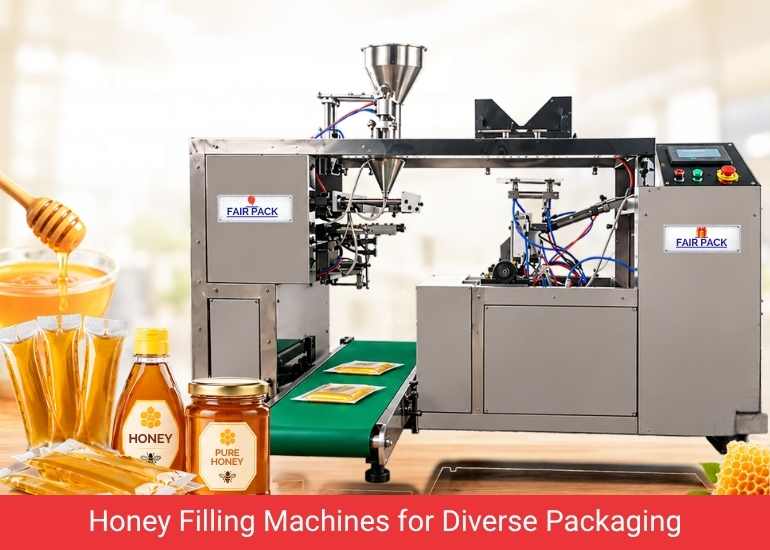
Honey Filling Machine for Diverse Packaging

How Honey Filling Machines Support Sachets, Bottles and Jars Packaging

Honey reaches consumers as single-serve sachets for hotels and promotions, squeeze bottles for everyday retail, and glass jars for premium ranges. A brand selling across these formats needs a filling process that adapts without compromising quality or hygiene.

A well-configured Honey Filling Machine provides that flexibility while supporting fill accuracy, production efficiency, and reduced manual handling. Manual filling struggles with honey’s slow flow, and stringing, dripping, and uneven fills create waste and cleaning effort.

Sachets, bottles, and jars are different packaging applications with different handling needs, not entirely separate worlds. Container behaviour, sealing, and positioning vary even when the filling principle is similar.

Fair Pack Machineries, a manufacturer, exporter, and supplier of liquid packaging machines and automated packaging solutions for food industries, approaches honey packaging with this application-first view.

A honey filling machine lets manufacturers pack sachets, bottles, and jars with controlled dispensing and less manual handling. This article explains how each format differs in handling, sealing, and conveyor needs. It also covers how viscosity, changeovers, and line integration affect selection, and how Fair Pack Machineries supports flexible honey packaging for brands and contract packers.

Why Honey Packaging Requires a Flexible Honey Filling Machine

Honey reaches consumers as single-serve sachets for hotels and promotions, squeeze bottles for everyday retail, and glass jars for premium ranges. A brand selling across these formats needs a filling process that adapts without compromising quality or hygiene.

A well-configured Honey Filling Machine provides that flexibility while supporting fill accuracy, production efficiency, and reduced manual handling. Manual filling struggles with honey’s slow flow, and stringing, dripping, and uneven fills create waste and cleaning effort.

Sachets, bottles, and jars are different packaging applications with different handling needs, not entirely separate worlds. Container behaviour, sealing, and positioning vary even when the filling principle is similar.

Fair Pack Machineries, a manufacturer, exporter, and supplier of liquid packaging machines and automated packaging solutions for food industries, approaches honey packaging with this application-first view.

We’re Just a Call Away
Contact Now!

How a Honey Filling Machine Works for Different Packaging Formats?

An automated honey filling process follows a sequence. Honey is fed from a hopper or supply tank, containers are positioned under the dispensing point, a controlled volume is delivered through a nozzle, and the filled container moves on.

Nozzle design and dispensing control influence how cleanly product cuts off after each fill, which affects drip and container cleanliness.

Bottles and jars are typically indexed on a conveyor and aligned beneath the nozzle. Sachets are formed from film, filled, and sealed in the same cycle.

Configuration therefore matters more than machine type. Nozzle size, feeding arrangement, container guides, and dispensing settings should match the format. Buyers discussing a configuration with Fair Pack Machineries should be ready to describe their container and honey type.

Honey Sachet Filling Machine: Supporting Single-Use and Small Portion Packaging

A honey sachet filling machine serves small, portion-controlled packs for hospitality, airline and catering supply, sampling, and FMCG promotions. Portion control is the defining requirement.

Sachets add considerations that rigid containers lack. Film must be unwound, tracked, and formed into a pouch before filling and sealing.

Film type, seal integrity, and honey handling near the seal area all affect pack quality, because residue in the seal zone can compromise closure.

For brands, sachets offer a low-cost trial format. For manufacturers, forming, filling, and sealing happen in one workflow, reducing handling steps.

Honey Bottle Filling Machine: Improving Efficiency for Retail Packaging

A honey bottle filling machine is typically used for retail packs, where shelf presentation and clean, drip-free containers matter.

Bottle handling revolves around alignment. Containers must be fed, spaced, and positioned accurately under the nozzle, so shape, neck size, and stability shape the guide and conveyor setup.

Lightweight plastic bottles may need more careful positioning than heavier glass ones.

Conveyor integration links the filler with capping and labelling, so containers move through the line in a controlled way. The practical gain is reduced dependence on manual filling.

Honey Jar Filling Machine: Handling Premium and Larger Pack Formats

A honey jar filling machine addresses wider-mouth containers used for premium, artisanal, or larger retail and bulk packs. Jars are often glass, so clean filling and tidy rims matter.

Container stability becomes important as weight increases during filling. Guides, supports, and conveyor design need to keep jars steady and centred.

Wider openings also allow different nozzle choices than narrow bottle necks. Jar formats serve retail and bulk buyers, so the setup should reflect the full range of sizes planned.

Our Other Product

Volumetric Packing Machine

Key Factors to Consider When Selecting a Honey Filling Machine

Selection starts with the product and container, not the machine catalogue. The main considerations are:

  • Honey viscosity: Viscosity varies with honey type and temperature, and it affects flow, nozzle choice, and feeding arrangements.
  • Filling volume: The range of fill sizes the line must cover determines dispensing setup.
  • Container type and shape: Sachet film, bottle geometry, and jar dimensions each drive handling design.
  • Packaging material: Plastic, glass, and film behave differently in positioning and sealing.
  • Production requirements: Define expected output and shift patterns, and confirm speed and capacity figures against Fair Pack Machineries’ official product information.
  • Cleaning and maintenance: Honey is sticky, so easy cleaning and access to product-contact parts affect uptime and hygiene.
  • Machine integration: Compatibility with capping, sealing, labelling, and conveyors should be considered up front.

Managing Multiple Honey SKUs with a Flexible Honey Filling Machine

Many honey businesses run several pack sizes and variants, such as different weights, blends, or flavoured honey. Each SKU adds planning complexity.

Grouping similar formats into one run and sequencing related products together reduces the number of changes. Changeover depends on what actually changes: nozzles, guides, film format, or settings.

Tool-light adjustments and clear settings records help shorten downtime.

A flexible system lets a brand or contract packer serve different customers, small-batch orders, and seasonal demand without a separate line for every format.

Honey Filling Machine for Small, Medium and Large Production Requirements

Scale shapes configuration. Small-batch packers value quick setup, easy cleaning, and short runs across several pack types.

Mid-sized brands need steadier output with planned changeovers. Large brands and contract packers prioritise continuous operation and tight downstream integration.

Because capacity varies by model and configuration, buyers should share target volumes and shift patterns with Fair Pack Machineries and request confirmed performance data rather than generic figures.

Integrating a Honey Filling Machine with Complete Packaging Lines

A filler rarely works alone. Containers enter on a conveyor, are filled, then move to sealing or capping, labelling, and secondary packaging such as cartoning or case packing.

Bottles and jars depend on conveyor spacing and stable transfer between stations. Sachets rely on the sealing stage built into the forming and filling cycle, followed by counting, grouping, and outer packing.

Planning these connections early prevents bottlenecks where one slower station limits the line. As a supplier of automated packaging solutions, Fair Pack Machineries can look at the filler and its neighbouring equipment as one workflow.

Need More Information?
Message us on WhatsApp Email Us Today!

Benefits of an Automated Honey Filling Machine for Brands and Contract Packers

Automation delivers benefits across the operation, not at a single step:

  • Less product loss: Cleaner cut-off and fewer manual spills reduce giveaway and rework.
  • Hygiene: Enclosed product paths and reduced human contact support food packaging standards.
  • Production control: Adjustable settings and repeatable cycles give supervisors clearer control over output.
  • Lower labour dependency: Operators shift from manual filling to monitoring and quality checks.
  • Quality assurance: A controlled, repeatable path from filling to final packing makes sampling, documentation, and traceability easier.
    Scalability: Additional formats or higher volumes can be planned as line extensions instead of process rebuilds.

How to Choose the Right Honey Filling Machine for Your Packaging Needs

Start with the format: sachets, bottles, jars, or a combination. Then define volumes, container specifications, and production requirements.

Review container handling needs and how often you will change between formats. Confirm compatibility with your conveyors, sealing, and labelling equipment.

Consider future expansion, since adding a pack size later is easier if the original selection allowed for it.

Share your honey type, target formats, and production goals with an experienced supplier. Fair Pack Machineries works with food manufacturers on honey filling machines and related liquid packaging solutions, and can advise on configurations suited to your packaging plan.

x

Call now

    agree that Steeler will collect my name and email information
    ×